
The expanded data provides terminal-level visibility across a larger share of the global airport retail landscape. Airports, concessionaires, food & beverage (F&B) operators and brands can access more detailed information on passenger nationality, travel destinations and whether passengers are connecting or non-connecting.
The additional level of detail reflects differences that can exist between terminals within the same airport, where passenger profiles may vary according to destinations, airlines, journey types and connection patterns.
According to m1nd-set CEO and owner Dr Peter Mohn, the development focuses on understanding the “passenger behind the passenger number”: “Airport passenger totals can conceal significant differences within the same airport. One terminal may serve predominantly short-haul European leisure traffic, while another handles long-haul international routes. One may have a high proportion of originating passengers, while another is dominated by connecting traffic. The nationality mix can also differ considerably according to the destinations and airlines served.”
Mohn continued: “Until now, terminal level traffic analysis was available for only a relatively small number of airports. Extending this capability to 188 airports through m1nd-set’s B1S provides a much broader and more representative view of the global passenger markets that underpin airport commercial activity.”

Anna Marchesini, Head of Business Development at m1nd-set, said the differences in passenger profiles can affect commercial activity across airport terminals: “A terminal with a high proportion of long-haul Asian passengers, for example, may represent a very different opportunity for beauty, luxury, gifting or premium spirits than another terminal within the same airport serving predominantly European short-haul leisure traffic.
“Similarly, the F&B proposition can be influenced by the passenger profile. Different nationality mixes, journey lengths, connection patterns and dwell times can affect demand for coffee, quick-service food, sit-down dining, local cuisine and international concepts” Marchesini added.
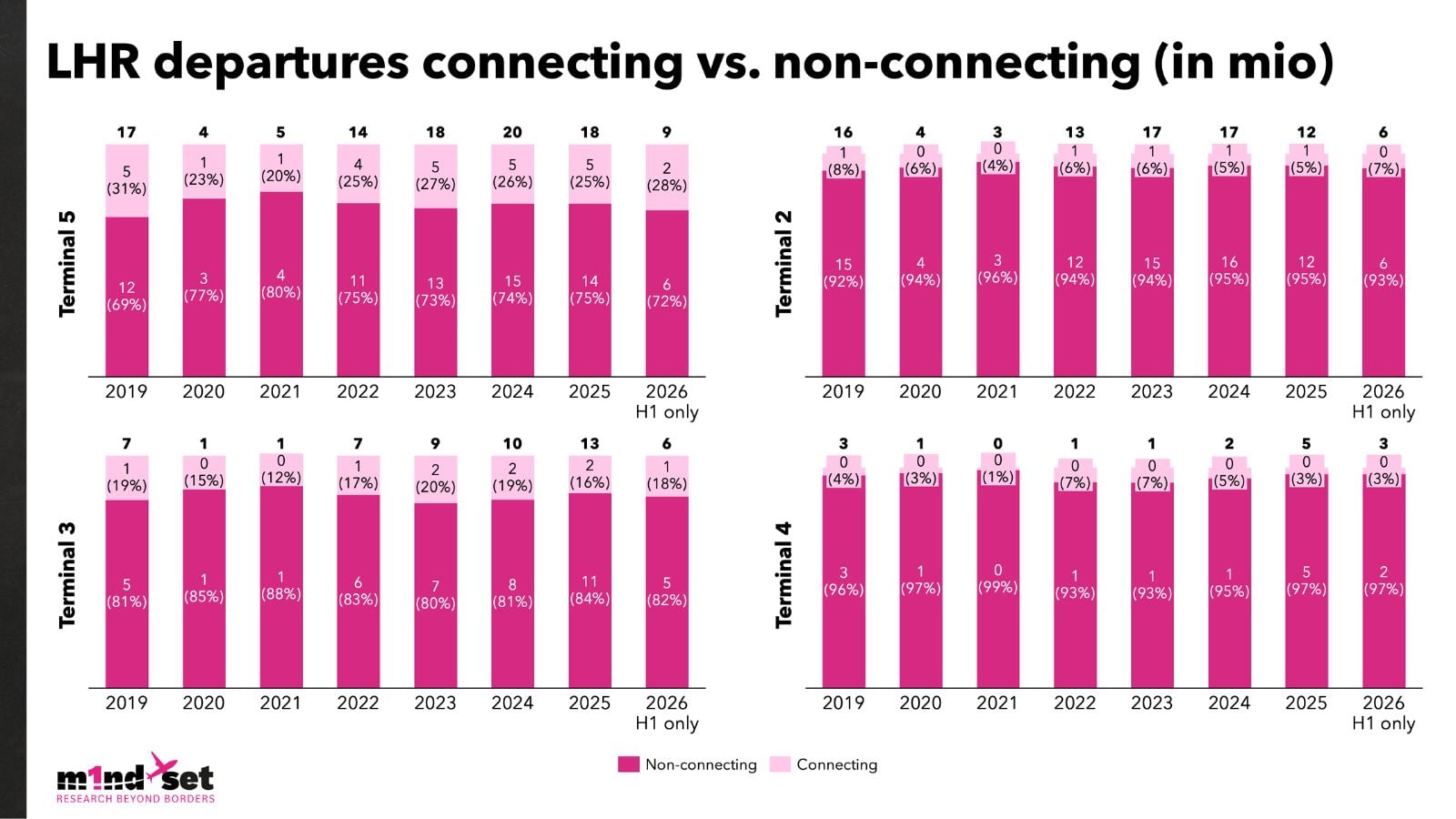
An analysis of London Heathrow, Singapore Changi, Dubai International, New York JFK and São Paulo Guarulhos illustrates differences in passenger composition between terminals, according to m1nd-set. Across the five airports, the analysis identifies distinct passenger audiences that are not visible in airport-wide traffic figures.
- At London Heathrow, passenger traffic was substantially redistributed in 2025, with Terminal 2 losing share, Terminal 4 recording strong growth and Terminal 5 remaining the largest terminal.
- Singapore Changi also shows distinct terminal profiles. Terminal 1 handled the most passengers, Terminal 3 recorded the strongest connecting traffic and Terminal 4 was predominantly point-to-point.
- At Dubai International, Terminal 3 remained the dominant transfer hub, while the rapidly growing Terminal 1 was almost entirely point-to-point.
- New York JFK was predominantly a point-to-point airport, with more than 85% of passengers non-connecting across its major terminals.
- São Paulo Guarulhos recorded a record level of international traffic in 2025, with around three-quarters concentrated in Terminal 3. The terminal has a larger international and intercontinental passenger base and a more diverse global traveller profile.
According to IATA and m1nd-set, the terminal-level passenger intelligence can be used across terminal planning, concession strategy, retail zoning, store formats, category mix, space allocation and investment. For brands, the data can also identify terminals and passenger groups relevant to their propositions, supporting more targeted assortments and activations.

Marc Heinicke, Assistant Director, Travel and Tourism Economic Business Intelligence, at IATA, said that bringing passenger intelligence to terminal level connects traffic data more closely with the physical point of purchase and shopper insights: “For travel retail, knowing the total number of passengers using an airport is only the starting point. The real commercial question is understanding who those passengers are, where they are travelling and, increasingly, which terminal they are using. By bringing nationality, origin and connection data down to terminal level, we can give airports, retailers and brands a much clearer view of the passenger opportunity they are actually addressing. This can help reduce the risk of making major decisions about store design, category management or investment based simply on airport-wide averages.”

Mohn added that the expansion is intended not only to increase the volume of available data but also to provide more detailed information for commercial decision-making: “The objective is not simply to count more passengers. It is to understand their composition in a way that can help the travel-retail industry make more informed commercial decisions. The expansion from 38 to 188 airports therefore represents more than an increase in data coverage. It provides a much more detailed view of the global airport retail landscape, at a level where passenger composition, journey type and commercial opportunity can differ significantly.”
Mohn concluded: “In an industry increasingly focused on consumer relevance and data-led decision-making, this represents an important step towards turning air-traffic intelligence into actionable retail intelligence.”
Tags: Dr Peter Mohn m1nd-set Anna Marchesini Marc Heinicke IATA

