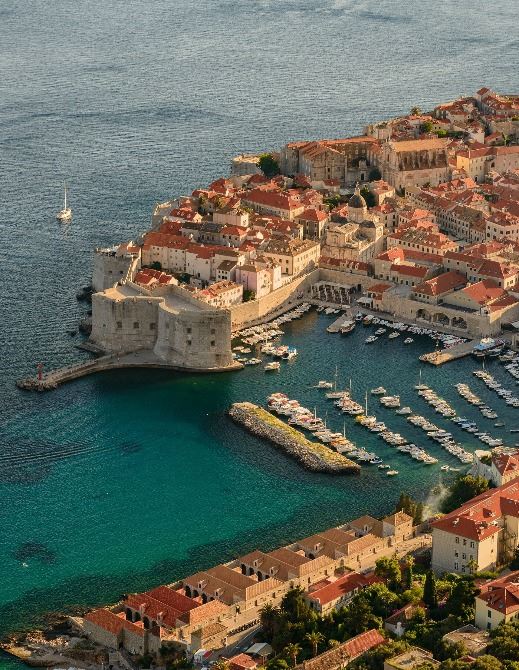
The Croatian city has spent almost a decade addressing the pressures associated with high visitor volumes. During that period, local authorities have shifted their focus from responding to overtourism during periods of severe congestion to implementing a longer-term destination management strategy.
From the beginning of 2026 to mid-July, Dubrovnik recorded almost 650,000 arrivals and two million overnight stays. The United Kingdom, the United States, France, Germany, Poland, Ireland, Spain, Canada and Australia were among its largest international source markets, while the city also maintained demand from domestic travellers.
The city’s current approach is focused less on attracting additional visitors and more on distributing tourism activity across different times, locations and visitor categories.

Mato Franković, Mayor of Dubrovnik, told Euronews Travel: “Here, it’s not just about the numbers,” adding: “Also important is how the flow of numbers is spread throughout a day and across the week.” According to Franković, the city’s tourism sector previously expanded without sufficient coordination between visitor categories and arrival schedules. “For years, tourism in Dubrovnik wasn’t managed, it simply just ‘happened’ on its own,” he said. He added: “Previously, there would be days where five or six cruise ships would arrive at once, bringing with them so many day-trippers from nearby destinations. That’s when we realised we needed to manage tourism differently, so we divided it into different sectors.”
Franković, a Dubrovnik native who has served as mayor since 2017, has based much of the city’s tourism strategy on the Respect the City initiative. The programme was launched in 2017 in response to the pressure placed on the UNESCO-listed Old Town by concentrated visitor flows. “Respect for Dubrovnik is something we ask of everyone: citizens, people working in the city, those who come to enjoy Dubrovnik – this is our message to everyone,” he said.
During the 2010s, the Old Town experienced increasing pressure from cruise arrivals, lower-cost air connectivity and the destination’s international exposure following the success of the HBO television series Game of Thrones.
The combination contributed to severe summer congestion and increased pressure on the historic centre during peak periods. “So much so, you could hardly walk or go around to enjoy the city,” Franković said.
Dubrovnik now manages tourism through separate categories covering cruise passengers, day visitors and overnight guests, rather than treating all arrivals as a single visitor flow.
Under the Respect the City initiative, no more than two cruise ships may dock at the city’s port simultaneously, with a combined maximum of 4,000 passengers. Cruise calls must also last for at least eight hours.
The longer port stays are intended to encourage cruise passengers to visit different parts of the city and surrounding region rather than concentrating in the historic centre during the same limited period.
“We’ve seen that visitors are now choosing to explore more excursions elsewhere,” Franković said. “Of course, they still visit the Old Town at some point, but the traffic is now not all at the same time, compared to previously when six cruise ships would arrive and dock for just four hours.”
Figures from the Dubrovnik Port Authority indicate that the city expects to receive more than 661,000 cruise passengers through 461 ship calls by the end of 2026.
The Respect the City programme also regulates the movement of day visitors arriving by coach from neighbouring Bosnia and Herzegovina, Montenegro and nearby Croatian islands.
Coach operators must reserve arrival slots before entering the city through an online bus booking system. The platform enables officials to distribute arrivals throughout the day and adjust available capacity according to scheduled events and fluctuations in demand.
For overnight visitors, the digital Dubrovnik Pass serves both as an admission product and a visitor management tool. It includes access to city museums and public transport, while enabling the authorities to recommend less congested times for visiting popular attractions. “Because it’s digitalised, we are able to message visitors with the best times to visit attractions, such as the Old City,” Franković said. He added: “This is something we are especially working to fine-tune: avoiding situations where hundreds and hundreds of people are walking the city at the same time. We want people to choose the best times so they can enjoy the city with their families.”
The city is also increasing its use of data in the development of tourism policies. Visitor counters have been installed across the Old Town to monitor pedestrian activity and identify periods of concentrated footfall.
The information is shared with the University of Dubrovnik, which analyses tourism patterns and provides recommendations for further adjustments to the city’s visitor management measures.
Despite Dubrovnik’s international profile, city officials have identified areas within and around the destination that receive comparatively limited visitor traffic. “There are many areas that are still undiscovered, take Mount Srđ, for example.”
Mount Srđ overlooks the Old Town, the Adriatic Sea and the surrounding islands. The AllTrails outdoor activities platform recommends visiting the area later in the day for sunset views.
Rather than creating additional tourism hotspots, the city plans to encourage visitors to explore existing attractions while improving the overall quality and management of tourism services.
The same approach is influencing future urban development. Underdeveloped areas previously designated for tourism are being considered for affordable housing intended for local residents.
Franković identified the expansion of short-term rentals as a wider challenge affecting Dubrovnik and other European cities, particularly where residential neighbourhoods are increasingly converted into visitor accommodation.
 |
| Photo: Visit Dubrovik |
“Short-term rentals are killing cities because step by step, they push residents out and turn living neighbourhoods into tourist apartment zones,” he said. “It’s going to be just like a generic Disney-land experience, and who wants to visit a ghost town? “That’s not what people want – they want to see and meet the citizens. But if we let this continue, our citizens will be forced out of the major cities and into the far away suburbs. “I hope in the future this won’t continue to be an issue where locals struggle to find good places to live. In fact, there are many villages around us that are now abandoned and they have potential to become great living zones.”
The permanent population of Dubrovnik’s Old Town has declined to approximately 1,500 residents, compared with around 5,000 in 1991.
Dubrovnik’s visitor management policies have attracted interest from other European destinations. Franković said the city works with regional counterparts and that European local authorities are increasingly exchanging information on tourism pressures and policy responses.
For the city’s longer-term development, the mayor said the objective is not necessarily for Dubrovnik to become larger, but to retain its existing identity and historic character. He also referred to the potential development of a comprehensive and reliable national rail system in Croatia, alongside the preservation of Dubrovnik’s heritage and natural environment. “My hope is that someone will return in 30 years’ time and find the same Dubrovnik. The same beauty, the preserved historical site and clear sea.”
Tags: Mayor Mato Franković, Dubrovnik

