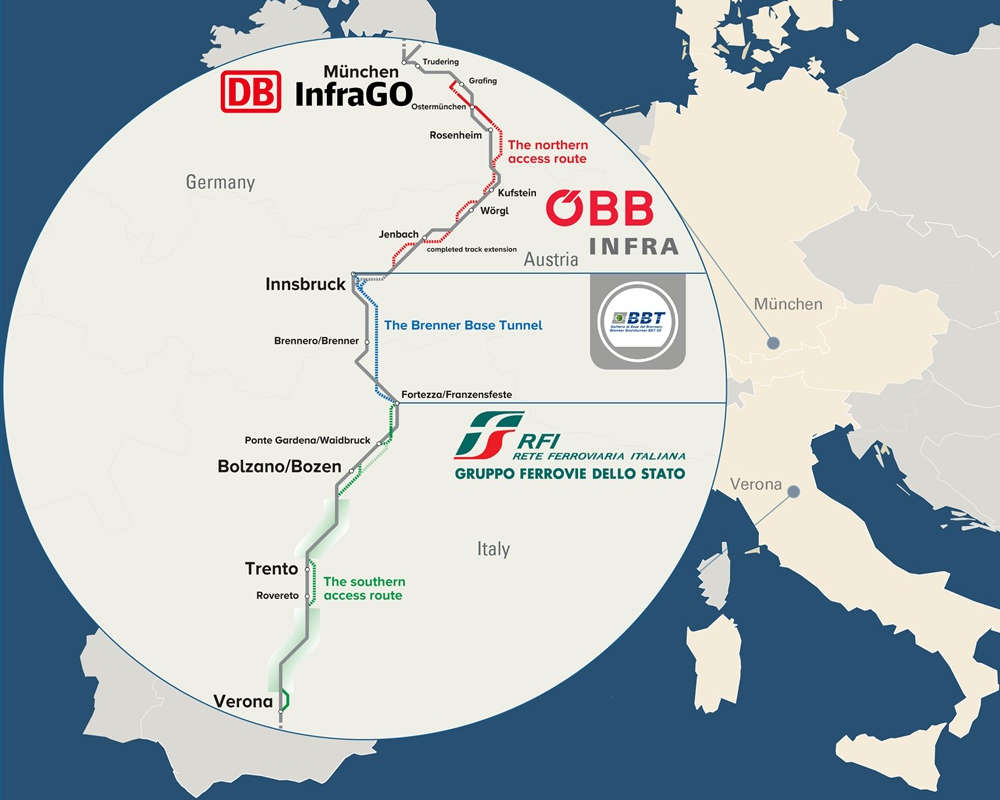
The breakthrough took place on July 28 beneath the Austrian-Italian border, where construction teams working from both countries met almost simultaneously in the east and west tunnel tubes around 1.4 kilometers below the Brenner Pass.
Austrian crews excavated their section using conventional drill-and-blast techniques, while the Italian side was completed using tunnel boring machines (TBMs).
The achievement follows the breakthrough of the exploratory tunnel in September 2025, meaning Austria and Italy are now connected through all three cross-border tunnels. Engineers reported the final breakthrough was completed with surveying accuracy measured in just a few centimeters.
Around 220 kilometers of the planned 230-kilometer tunnel network has now been excavated. Construction will continue on the remaining sections north toward Innsbruck before work shifts to railway systems, tracks and signaling.
BBT SE executive board members Martin Gradnitzer and Umberto Lebruto described the breakthrough as another major step toward transforming rail travel across the Alps.
“With the connection of the two main tunnels, our project has reached another major milestone,” they said. “In the future, freight and passenger trains traveling between Austria and Italy will pass through here. This success demonstrates what can be achieved through cross-border cooperation.”
Travelers to experience improvements before the tunnel opens
Although the Brenner Base Tunnel will not enter service until the end of 2032, rail passengers will begin benefiting from improvements on the existing Brenner corridor much sooner.
During summer 2026, Austrian Federal Railways (ÖBB) completely closed the historic Brenner railway, which has been in operation for more than 150 years, to carry out essential maintenance and infrastructure renewal. Regular train services resumed on August 2.
The work focused on improving the reliability of the mountain railway ahead of the coming winter season. Engineers repaired frost damage inside the Mühltal Tunnel, renewed sections of track and carried out weatherproofing works designed to reduce disruptions caused by freezing temperatures, snow and ice on one of Europe’s most challenging Alpine rail routes.
Further improvements are also coming for international travelers. Deutsche Bahn plans to introduce new direct Frecciarossa high-speed services between Munich, Milan and Rome from the end of 2026. The new trains will eliminate the need to change trains across the Brenner corridor and provide a more comfortable rail option for leisure travelers, winter sports visitors and business passengers, even before the base tunnel opens.
Looking ahead to 2032
Once operational, the 64-kilometer Brenner Base Tunnel will become the world’s longest underground railway link. Its low-gradient alignment will allow trains to bypass the steep mountain route, making services less vulnerable to snow, ice and severe winter weather.
Journey times between Innsbruck and Fortezza in South Tirol (Franzensfeste) will fall from about 80 minutes to just 25 minutes, while freight capacity across the Scandinavian-Mediterranean TEN-T corridor will increase significantly, supporting Europe’s shift from road to rail.
However, the tunnel’s full potential may not be realized immediately. While Austria and Italy remain broadly on schedule, Germany’s northern approach line through the Bavarian Inn Valley continues to face delays.

