He recounted that moment in 2017 to the audience attending the Trip.com Airline Global Conference in Amsterdam last week. Akbar Al Baker of Qatar Airways had come up before him, declaring he was going to buy British Airways and basically everything else he could get his hands on.
“When I came up, you asked me what I was going to buy and I said, Qatar Air. Then I don’t have to buy anything else.”
Sixty-two years old now—he’ll tell you himself, birthday April 30—a grandfather, the founder of AirAsia and now the CEO of Capital A Group, he remains the original maverick he was when he dared to dream and start up an airline 33 years ago that has transformed the lives of a billion travelers in Asia and beyond.
The big mouth and the epiphany
He still loves telling his origin story, perhaps because he still can’t quite believe it himself—that a music man could change aviation.
The heady days of running Warner Music in Asia—dining with Madonna, jamming with Prince—then Warner became Time Warner and Time Warner merged with AOL in what Fernandes described as the most surreal boardroom experience of his life.
He was sitting in Rockefeller Plaza when Steve Case, AOL’s founder, turned to him and asked where he thought the stock price would be in a year. It was around $80 at the time. Case said: $500.
“I knew that was the end of my career, because my famous mouth opened and I said, please give me some of the drugs you are taking.”
He resigned, flew to London, sat in a bar. And then Stelios Haji-Ioannou appeared on television, talking about EasyJet. He took a bus to Luton Airport and watched people booking flights to Barcelona for nine pounds, Paris for six. Something clicked.
“There’s a very fine line between brilliance and stupidity,” he told the audience. “It’s very narrow. And I said: I can do that.”
He went back to Malaysia, met the Prime Minister and pitched his vision. The PM’s response has become one of his favorite lines: “This is a great idea. You’ll succeed because you’re not from the airline business.”
He bought AirAsia for 25 cents. Remortgaged his house. Started with two planes and 254 terrified staff—terrified, he noted, because they’d seen him on music shows and couldn’t quite reconcile that with the man now owning their airline.
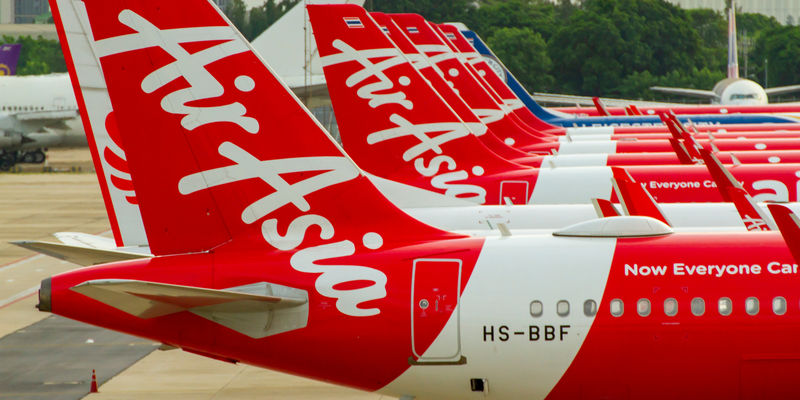
Twenty-five years later, AirAsia has carried nearly a billion people.
The hardest decade: Extending AirAsia’s brand and culture
I asked him which was the hardest of the three decades, from start to now. The scrappy underdog years, fighting off Malaysia Airlines and Singapore Airlines as they dropped fares to try and kill him? The explosive growth years? Or now?
He didn’t hesitate. “This decade. Definitely this decade.”
Starting an airline with two planes and 200 staff, he said, is actually easier than restarting one with 300 aircraft and 21,000 people. COVID cost AirAsia $10 billion in revenue. Unlike many of their competitors—Singapore Airlines received S$12 billion in government support, he stressed—they got nothing. They had to do it entirely themselves.
Unlike others who went into crisis management, he got into company building. “My cabin crew were delivering food. My pilots were taxi drivers.”
And in the middle of all that chaos, he built five new companies.
The engineering arm—Asia Digital Engineering—is now, by his account, the fastest in the world at doing a C-check. Air France is sending planes to them. Teleport, the cargo airline they built by literally pulling seats out of grounded aircraft, has become the number one cargo carrier in the Association of Southeast Asian Nations (ASEAN).
Their in-house travel platform, Move, is a small online travel agency (OTA)—“very tiny, very small, not a threat to Trip,” he said, smiling. Their food brand, Santan, is now moving into 500 grab-and-go locations. And they’ve built a branding company—AirAsia Next—licensing the AirAsia culture and name into other industries. A major hotel group is about to launch an AirAsia hotel. A multinational hospital group is opening an AirAsia hospital in Malaysia in the next six months.
“Low-cost model?” I offered.
He played along: “Halfway through your operation, there’ll be a small ancillary charge.”
Jokes aside, Fernandes said that AirAsia is no longer an airline. It is a philosophy. A way of treating people, of running a flat, union-free, opportunity-rich organization where someone who started carrying bags can end up a CEO or a captain.
Betting big in the hard times: Belief in travel and Asia
And if you’ve been following the news, you’d also have read the news that AirAsia has just ordered 150 aircraft from Airbus and De Havilland with Canada’s Prime Minister Mark Carney presiding at the signing ceremony.
How do you make such a big bet in a time of crisis when the Middle East crisis has sent the airline industry and the world into shock, amid fuel supply shortages and rising fuel prices?
“I’m a little bit contrarian,” he said. “A crisis is a great time to build market share when everyone else is thinking, what are we going to do?”
He got a great price. He knows this region. And he knows one thing above all else: Travel is sticky. In a recession, people cut other things before they cut travel. And in Southeast Asia, unlike Europe, you cannot take a train from Beijing to Kuala Lumpur. You cannot drive. The plane is the only option, and the low-cost model is what opened it up.
“Low-cost carriers have done an amazing job in our part of the world,” he said. “I started it and then every other animal was named an airline. Tigers, lions, loads of birds. Even one named after an insect—Firefly.”
On AI, partnerships and what comes next
He is a huge believer in artificial intelligence (AI), particularly in operations.
AirAsia has been working with it for some time, using it to optimize fuel burn based on aircraft age, route, altitude and load. The result: four percent fuel savings. Across a fleet the size of AirAsia’s, that is considerable.
On the customer side, he’s more measured. “A little rigid. Not quite there yet.”
But he believes it will eventually remove friction from the travel experience in ways that will transform the industry—echoing what KP Ho, chairman of Banyan Group said to me recently, that AI will be the next great unlocking force in Southeast Asia travel, just as low-cost aviation was the last one.
On partnerships, he was direct. Low-cost carriers have historically kept to themselves. He thinks that’s wrong. AirAsia has been building alliances: Wizz Air, Pegasus, ajet, easyJet. The goal is to stitch together the low-cost world so a passenger can move seamlessly across continents without defaulting to a legacy carrier or paying a premium.
Live and let die: Never take no for an answer
He closed, as he always does, with a story. During the Bali bombings, when every other airline was pulling flights, he went to his team and said: we do not cancel. These people need us at their worst moment as much as they needed us at their best. He gave away 5,000 free seats. “I knew Malaysians,” he said. “If you give a free seat, they’ll risk their lives. We don’t care about the bomb. We’re going to Bali. They went. They had a great time. They came back and told half a million people.”
Three decades on, from a man who bought an airline for 25 cents, built it into the fourth-largest in Asia, survived a pandemic without a cent of government support and somehow had time to claim credit for the MAGA hat, he concluded with this message. “Dare to dream. Believe the unbelievable. And when someone tells you no, you just say no right back. You never take no for an answer.”
I asked him, given his music background, what song best encapsulates AirAsia’s story. He paused. You could see him running through a mental playlist.
“Live and Let Die,” he said.
This story originally appeared on WiT.
Tags: Tony Fernandes Southeast Asia travel, low-cost aviation Air Asia

