
Will ChatGPT favor online travel agencies (OTAs)? Will hotel brands maintain visibility? Will direct booking survive when travel decisions increasingly happen through AI assistants rather than websites?
This week, OpenAI may have quietly offered us the first real clue. The company announced new personal finance capabilities inside ChatGPT, powered through a connection to Plaid, the infrastructure platform linking more than 12,000 financial institutions into a single trusted ecosystem.
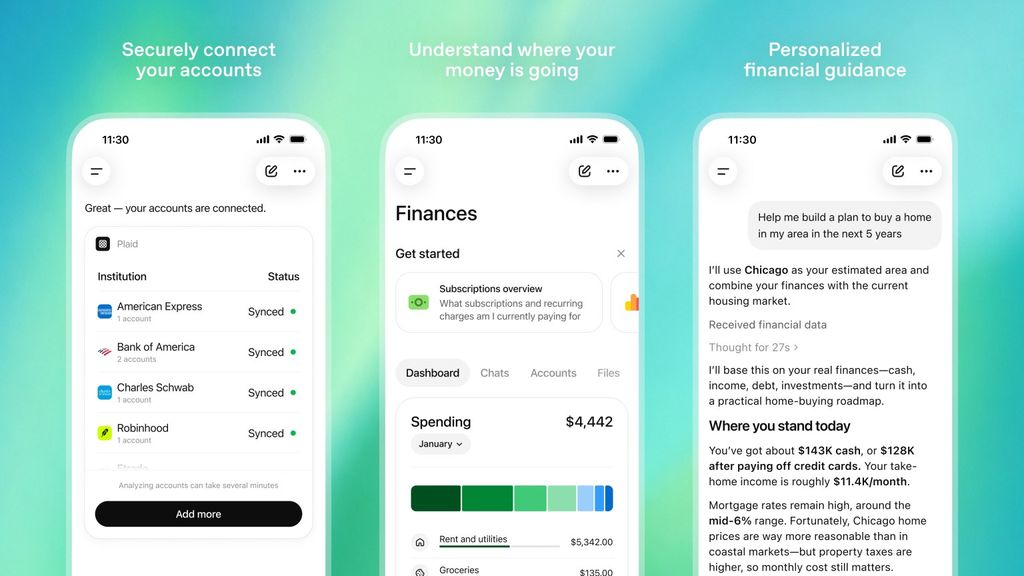
At first glance, this sounds like fintech news. It is not. It is a blueprint.
OpenAI did not integrate separately with thousands of banks. It did not try to untangle a fragmented ecosystem institution by institution. Instead, it connected to a neutral infrastructure layer that already standardized complexity.
One connector. One framework. One trusted interface to an entire industry.
That should set off alarm bells (and opportunity bells!) across hospitality.
Because for the first time, we may be getting a glimpse of how hotel distribution could eventually appear inside the generic ChatGPT experience—that very interface that nearly 900 million people now look at every week.
The question is not whether AI will sell hotel rooms. It will. The question is: who becomes hospitality’s Plaid?
Because as we know, the easiest path for companies like OpenAI or Anthropic is painfully obvious.
OTAs...
They already aggregate inventory. They already normalize content and pricing. They already provide structured application program interfaces (APIs). To an AI company trying to reduce complexity, OTAs represent the path of least resistance.
And if we let that happen unchecked, we are about to replay the last 25 years of hotel distribution history.
Once again, hotels become inventory suppliers sitting behind someone else’s interface. Only this time, the interface is not a website. It is AI itself. That should concern every hotel executive.
For decades, the industry has fought to reclaim direct customer relationships from intermediaries. Yet, while we debate AI-generated marketing copy and chatbot experiments, something much bigger is happening underneath us: The infrastructure of online discovery is being rebuilt.
Search is changing. Commerce is changing. Decision-making is changing. Increasingly, traveler intent will be interpreted, filtered, negotiated and fulfilled before a human ever reaches a booking page.
This is not a marketing shift. It is an infrastructure shift. And OpenAI just showed us how these systems are likely to work: through trusted, normalized, scalable connectors.
Hospitality needs one. We need a shared, industry-aligned infrastructure layer that allows AI systems to access trusted hotel data directly (availability, policies, loyalty rules, attributes, pricing and inventory) through open standards.
Call it what you want: DirectBooker, Hospitality model context protocol (MCP), OpenHotelGraph, AI Distribution Federation.
The name is irrelevant. The mission is not.
If we fail to offer AI-accessible infrastructure, someone else will step in—and they will own the interface, visibility, economics and customer relationship.
Again.
The good news is that this moment is still ours to shape.
For the first time in 25 years, hospitality has a narrow window to influence how digital distribution evolves before the architecture hardens around us. But that window will close quickly, because AI companies are not waiting for hotel committees to get comfortable.
This requires the industry to stop thinking tactically and start thinking collectively. Brands, owners, technology providers, standards organizations, academics, distribution leaders and yes, industry organizations, need to align around a simple reality:
We either build the rails, or someone else will.
This is not anti-OTA. OTAs will still matter in the AI era. But they cannot become the default operating system of AI-native hotel commerce before hospitality even shows up to the conversation.
Thirty years ago, we slept through the rebuilding of travel distribution and spent decades paying for it. We should not make that mistake twice.
For the first time in a generation, the infrastructure of discovery is being rewritten in front of us.
This is our moment. Let’s not sleep through it again.

