
April was a quieter month with demand nights down 7% year-over-year and occupancy slipping to 54.8%, part of a broader European pattern where supply growth has outpaced demand across the continent. In Greece, available listings actually contracted 3.6% YoY, which cushioned the occupancy decline. Greek hosts made the most of the contracting supply, with ADR rising 7.8% to €107.1 and RevPAR up 2.1% to €58.7 despite the softer occupancy reading.
That pricing confidence looks well-founded, given where summer is heading. Overall summer demand in Greece is pacing 9.3% above last year, with July (+13.5%) and August (+11.4%) leading the way. September is also gaining ground, up 12.4%, extending the season further into autumn. Greece's summer growth sits above the European average of 8.2%, and the country's 55% seasonal price premium (the steepest of any major European market) gives operators significant rate leverage as peak season approaches.
Key Takeaways
- Supply growth continued to outpace demand in April, driving occupancy lower across Europe even as ADR increased by 6.3% YoY.
- Summer pacing remains strong across all price tiers, with demand for June through September pacing 8.2% ahead of 2025 levels.
- Northern European and mid-market destinations continue to outperform, while countries such as Norway, Belgium, and the Netherlands remain among Europe’s least seasonal summer pricing markets.
Supply increased by 3.6% in April, while demand declined 5.7% YoY, pushing occupancy down 8.2% to 55.3%. Although demand nights continue to decline, summer pacing remains strong, with demand for June through September up 8.2% (Jun–Aug).
All price tiers are pacing positively, with mid-market segments including Economy (+7.3%), Midscale (+7.7%), and Upscale (+6.9%) leading occupancy gains, while Budget (+5.4%) and Luxury (+5.6%) lag at the extremes.
At a Glance: April 2026 STR Performance in Europe
- Available listings reached 3.71 million, an increase of 3.6% YoY
- Demand Nights declined by 5.7% YoY to a Total of 33.5 million
- Average daily rates (ADR) jumped by 6.3% YoY to €127.3
- Average occupancy rate declined to 55.3%, down 8.2% YoY
- Revenue per Available Rental Night (RevPAR) increased by 2.5% YoY to €70.4
April marked continued supply growth, with available listings up 3.6% year-over-year to 3.71 million. As supply expanded and demand declined 5.7% YoY to 33.5 million nights, occupancy fell 8.2% to 55.3%. On a positive note, ADR rose 6.3% YoY to €127.3, driving RevPAR up 2.5% to €70.4. Looking ahead, summer pacing remains strong across all price tiers, with mid-market segments (Economy +7.3%, Midscale +7.7%, Upscale +6.9%) leading occupancy gains for June–August.
The State of the European Economy
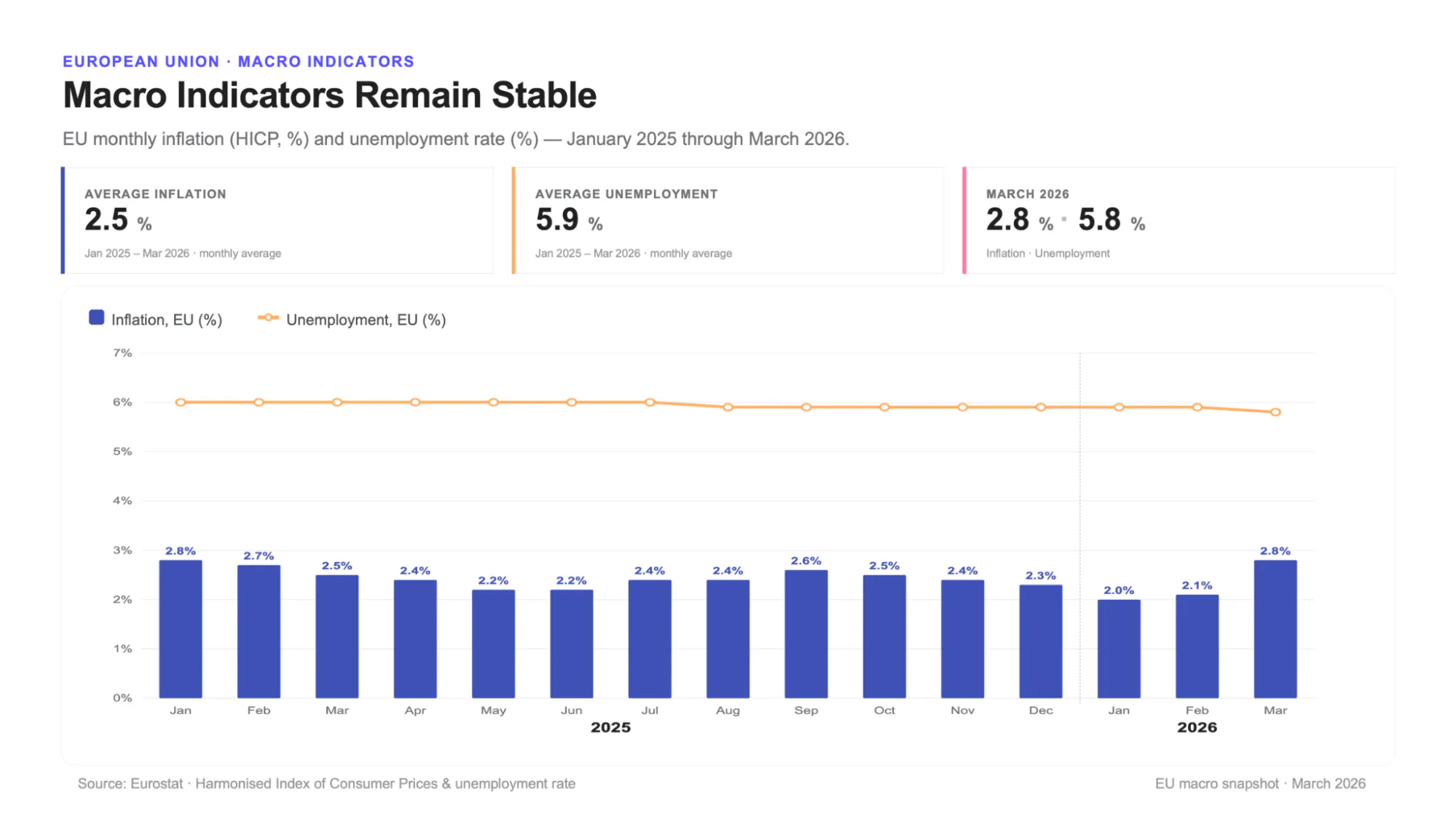
The escalation of the conflict in Iran continued to push energy prices higher through March, feeding into broader European inflation. Eurozone inflation rose to 2.8% in March, up from 2.1% in February and 2% in January, marking the sharpest monthly increase since the early 2024 energy shocks. However, inflation remains close to the ECB’s medium-term target of 2%.
Whether the ECB adjusts interest rates in the coming months will depend largely on two factors: how long the conflict continues to disrupt energy flows and how persistently elevated energy prices feed into core inflation. With inflation having spent most of 2025 trending downward toward the 2% target, March's reversal is notable but not yet structural. If energy prices stabilize as Oxford Economics expects by Q3, inflation should ease back toward target levels without requiring a rate response.
On a more positive note, labor markets across Europe have remained resilient throughout this period of geopolitical and economic uncertainty. EU unemployment stood at 6.0% in March, unchanged from February and within the narrow 5.9–6.1% range that has held steady since early 2024.
For Europe’s short-term rental market, the combination of rising travel costs and stable employment may shift travel patterns rather than reduce travel overall. As noted in the previous European Review, domestic demand makes up a substantial share of total STR demand in Europe’s largest markets, with France (67%), the United Kingdom (66%), and Germany (55%) leading in 2025. With higher fuel prices likely constraining long-distance international travel, these markets may be better positioned to offset weaker foreign demand through stronger domestic activity, as travelers choose to stay closer to home rather than abandon travel altogether.
How Is Your STR performing?
Your vacation rental may be amazing, but is it better than your competition? Connect your Airbnb listing to AirDNA to see its Booking Performance Score.
Supply Growth Stable in April
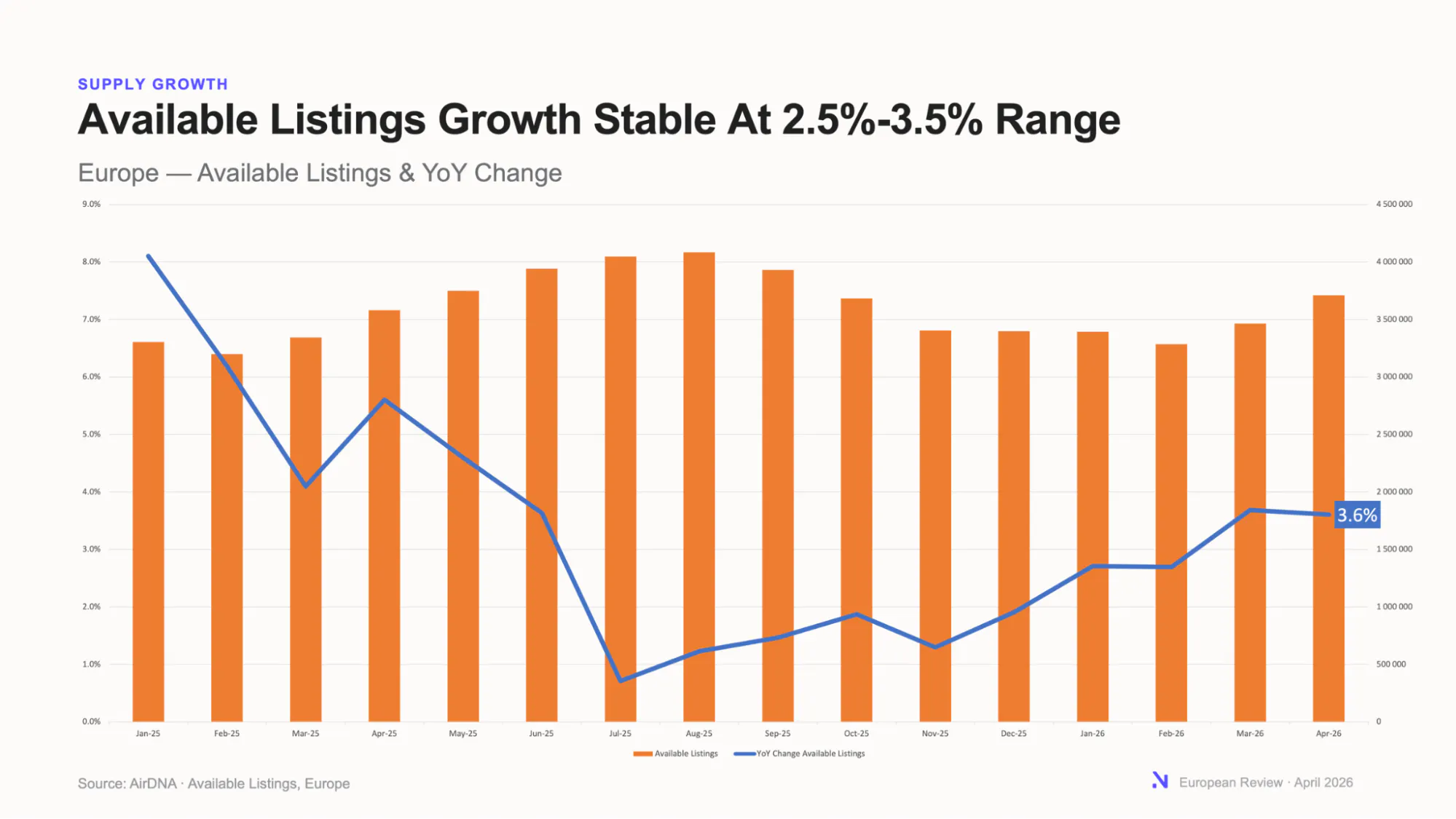
Available listing growth in Europe held steady through April, with available listings reaching 3.71 million, a 3.6% YoY increase broadly in line with March's 3.7% growth. This continues the recovery from July 2025's low of 0.7% YoY and reflects a more sustainable pace of expansion. The market has now added approximately 130,000 available listings compared to April 2025 and more than 320,000 compared to April 2024, signaling steady absolute growth even as YoY gains normalize into the mid-single digits.
New listings entering the market for the first time also continued their recovery, climbing 8.8% YoY in April to 147,000 listings, essentially matching April 2024 levels after the steady declines that defined most of 2025. Combined with March's 12.6% YoY increase, the three-month moving average for new listings has now risen for five consecutive months, suggesting the pipeline of new properties continues to rebuild after the slowdown in the second half of 2025.
Demand Nights & Nights Booked See Decline Over 2025 but Gains Over 2024
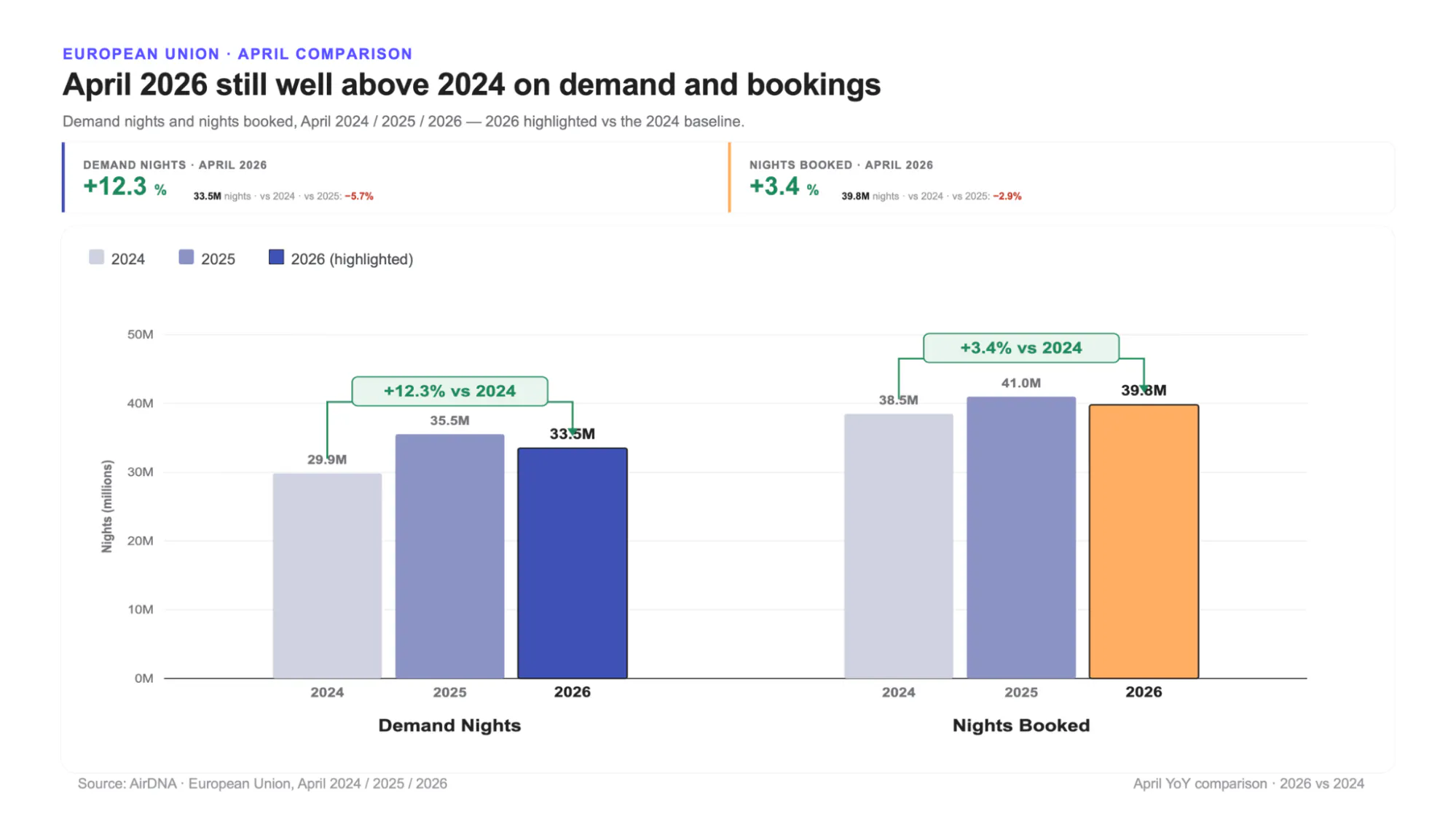
Demand nights extended their decline into an eighth consecutive month in April, falling 5.7% YoY, the steepest drop in the current streak that began in September 2025. Nights Booked, which includes reservations made during the reporting month for stays in current or future months, also declined for an eighth straight month, down 2.9% YoY.
While both metrics continue to weaken, the 2025 comparison base remains unusually strong, partly because Easter shifted from March in 2024 into April in 2025, concentrating holiday travel into a single month and inflating April 2025’s baseline. April 2025 itself posted 19.1% YoY demand growth and 6.5% YoY booking growth, distorting the year-over-year comparison.
Against April 2024, however, April 2026 demand nights remain up roughly 12%, while Nights Booked are up around 3%. Rather than pointing to a market in retreat, the data suggests the European STR market is normalizing after an unusually strong year, with both metrics still tracking comfortably above 2024 levels.
Occupancy Declines in Most Nations as Supply Growth Accelerates
As demand continued to decline (-5.7% YoY) and available listings expanded (+3.6% YoY), occupancy in Europe fell 8.2% YoY in April to 55.3%. However, the decline looks less severe when compared to 2024 rather than 2025, with occupancy still up roughly 5%. The Easter calendar shift, which concentrated holiday travel into April 2025, makes the YoY comparison particularly unfavorable for April 2026.
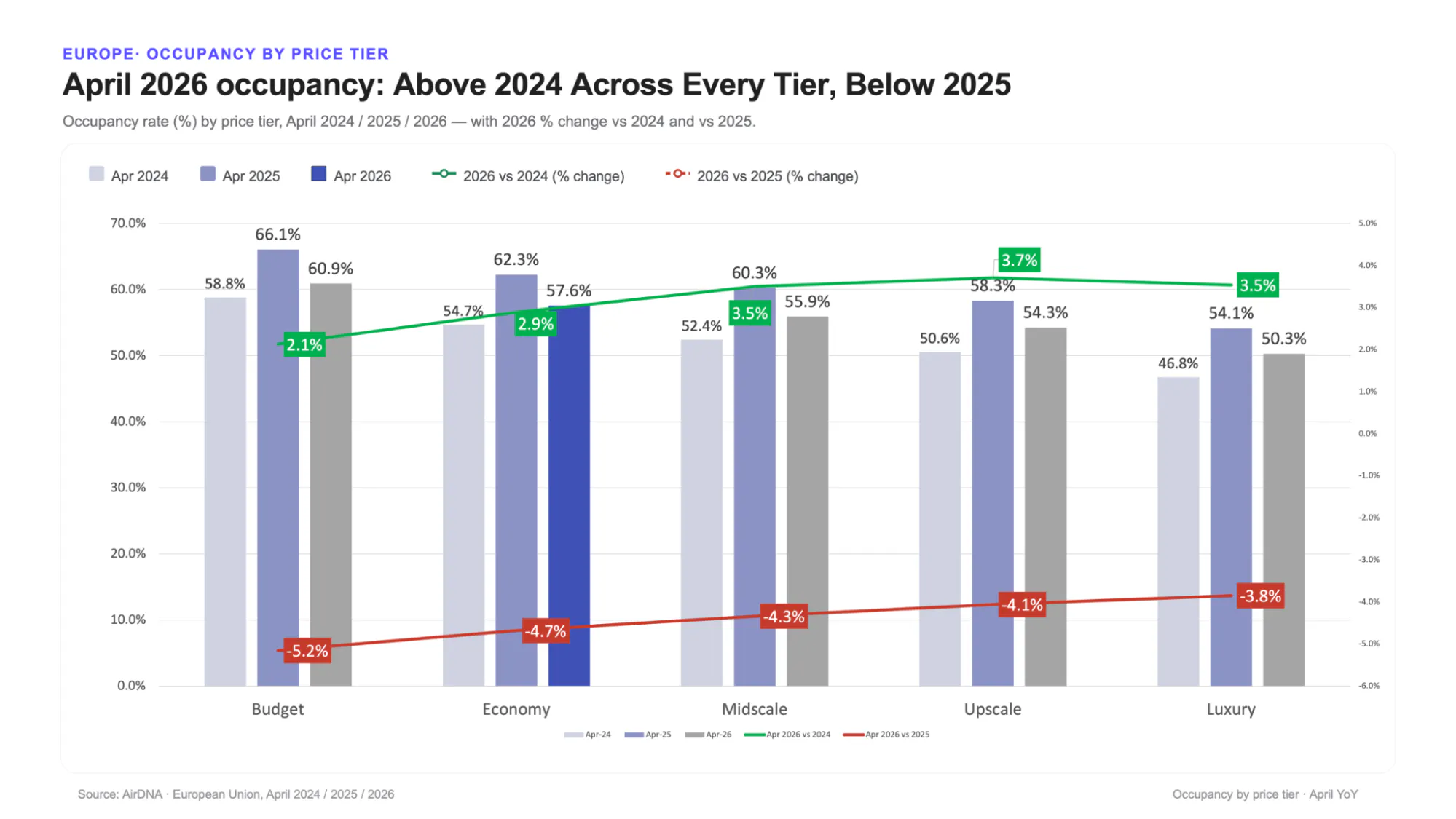
The K-shaped pattern that defined Q1 occupancy continues across price tiers, though April introduced a notable shift: every tier remains above its 2024 level even as all five declined against 2025. Budget listings posted the steepest YoY drop at -5.2%, falling from 66.1% occupancy in April 2025 to 60.9% in April 2026. Luxury listings, where travelers are generally less exposed to inflation pressures, held up best with a comparatively modest 3.8% YoY decline.
Compared to April 2024, however, every tier remains higher: Budget +2.1%, Economy +2.9%, Midscale +3.5%, Upscale +3.7%, and Luxury +3.5%.
Overall, the European market is preparing for a strong summer, with demand for the June–September period pacing up 8.2% compared to 2025. Growth is strongest across the core summer months (Jun–Aug), with even larger gains in the shoulder season. July leads at +12.7% YoY, followed by September (+10.2%) and August (+9.6%), reinforcing the trend of travelers extending trips beyond the traditional peak season. June remains the softest month at just +1.8%, suggesting most summer momentum is concentrated from July onward. With more European travelers potentially choosing domestic travel as overseas costs rise, this shift could help sustain demand throughout the season.
Despite strong demand pacing, occupancy gains remain modest. The core summer period (Jun–Aug) is up just +1 percentage point YoY (35.3% vs. 33.9%), while June has actually slipped by 1pp. This muted occupancy response reflects the ongoing supply-demand imbalance: even with robust demand growth, supply is expanding quickly enough to absorb most of it. Part of this is structural, as hosts increasingly activate listing nights ahead of the high season, inflating the available inventory base against which occupancy is measured. The result is a market where the absolute volume of demand nights is rising sharply (+7M nights for Jun–Aug alone), while the percentage of nights filled is barely moving.
ADR Recovers As RRI Continues Growing
Average daily rates in Europe extended their recovery for a second consecutive month, rising 6.3% YoY in April to €127.27. While slower than March’s 8.2% YoY surge, the continued growth confirms that the multi-month decline through the second half of 2025 has reversed.
The Repeat Rent Index (RRI), which tracks pricing changes among existing operators and excludes the impact of new listings, grew 5.9% YoY in April, broadly in line with March’s 5.8%. With ADR and RRI now moving in tandem, the gap that defined much of 2025, when established operators retained pricing power even as headline ADR declined, has largely closed.
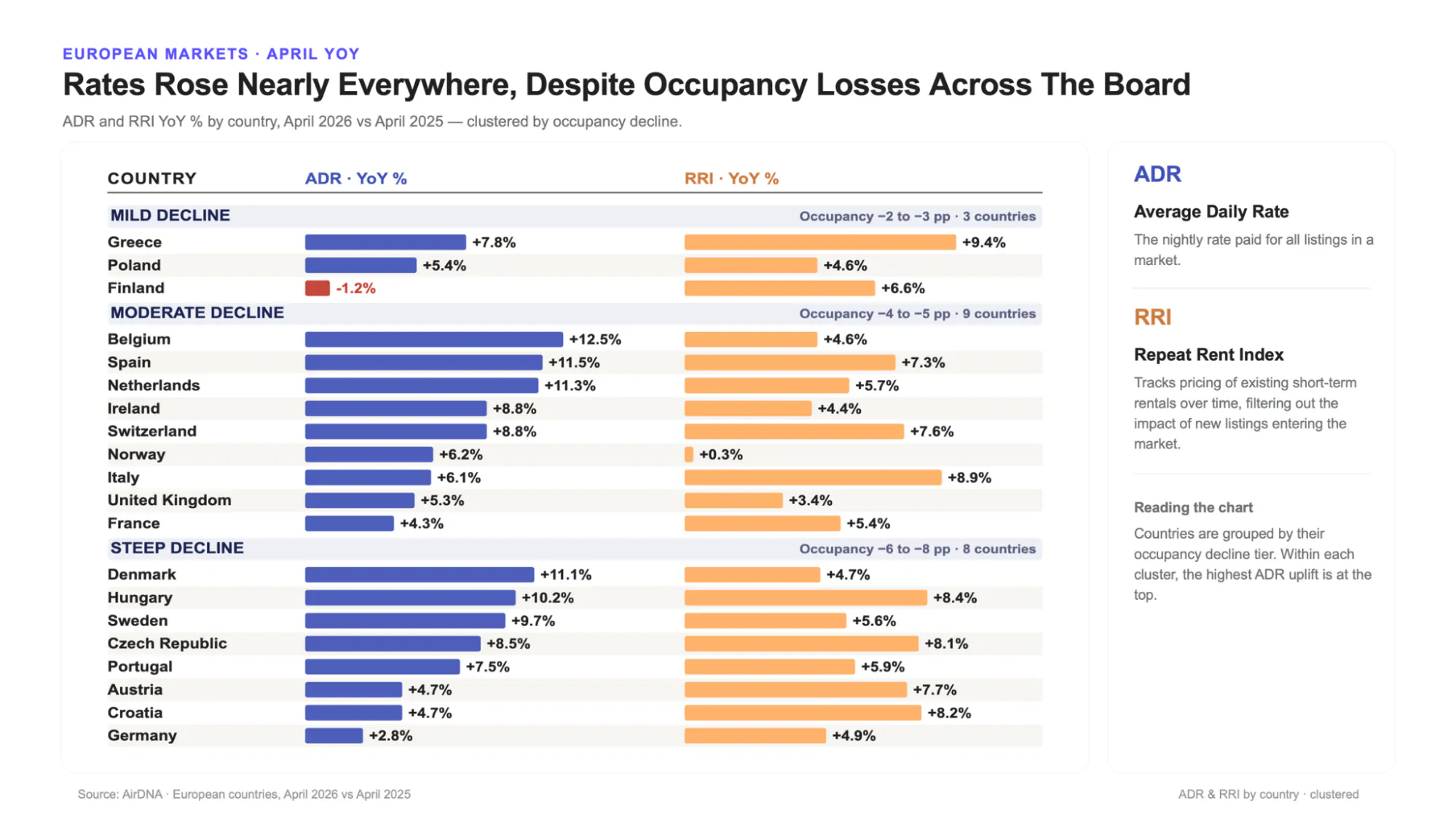
ADR growth was nearly universal across Europe’s top 20 nations, with 19 of 20 countries posting YoY gains and only Finland declining (-1.2%). Belgium (+12.5%), Spain (+11.5%), the Netherlands (+11.3%), and Denmark (+11.1%) led ADR growth, while Italy (+8.9%) and Hungary (+8.4%) posted the strongest RRI gains. Spain remains the standout major market, where contracting supply driven by regulatory delistings continues to support pricing power despite occupancy declines. Spanish ADR rose 11.5% YoY in April, while RRI climbed 7.3%.
What stands out most is how disconnected occupancy and pricing have become. Countries with some of the steepest occupancy declines, including Denmark (-8 pp) and Hungary (-6 pp), still recorded some of Europe’s strongest ADR gains. Meanwhile, markets with more modest occupancy declines showed no clear pricing advantage. Operators across Europe continue to maintain pricing discipline despite softer occupancy.
Research Airbnb Markets
Gain insights into the revenue and occupancy trends in your market.
European Summer Demand Continues to Accelerate
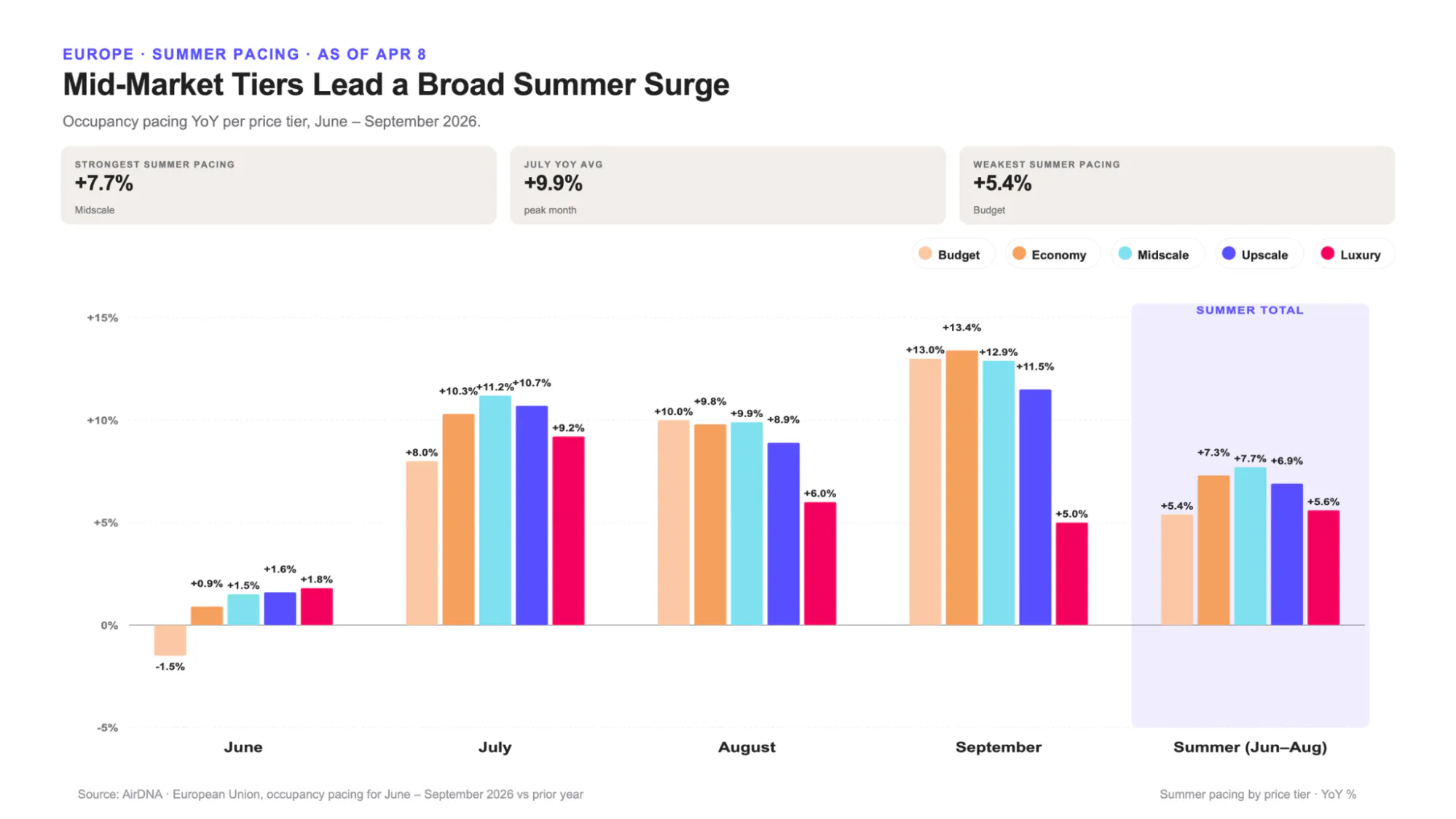
Despite geopolitical tensions, rising inflation risks, and potential pressure on economic growth, summer pacing across Europe remains strong. Demand for June through September is up across all price segments, with July (+9.9% YoY) and September showing the strongest gains. September continues to emerge as a key shoulder-season travel month, posting double-digit growth across most tiers, including Economy (+13.4%), Budget (+13.0%), Midscale (+12.9%), and Upscale (+11.5%). June remains the softest month, with Budget listings slightly behind last year (-1.5%) and other segments seeing only modest growth.
The K-shaped trend that defined Q1 has also evolved. Mid-market segments, including Economy (+7.3%), Midscale (+7.7%), and Upscale (+6.9%), are now leading occupancy gains for the core summer months (Jun–Aug), outperforming both Budget (+5.4%) and Luxury (+5.6%). This suggests travelers are increasingly prioritizing value, shifting away from both the highest- and lowest-priced stays toward the middle of the market.
Top 20 European Nations Summer Pacing
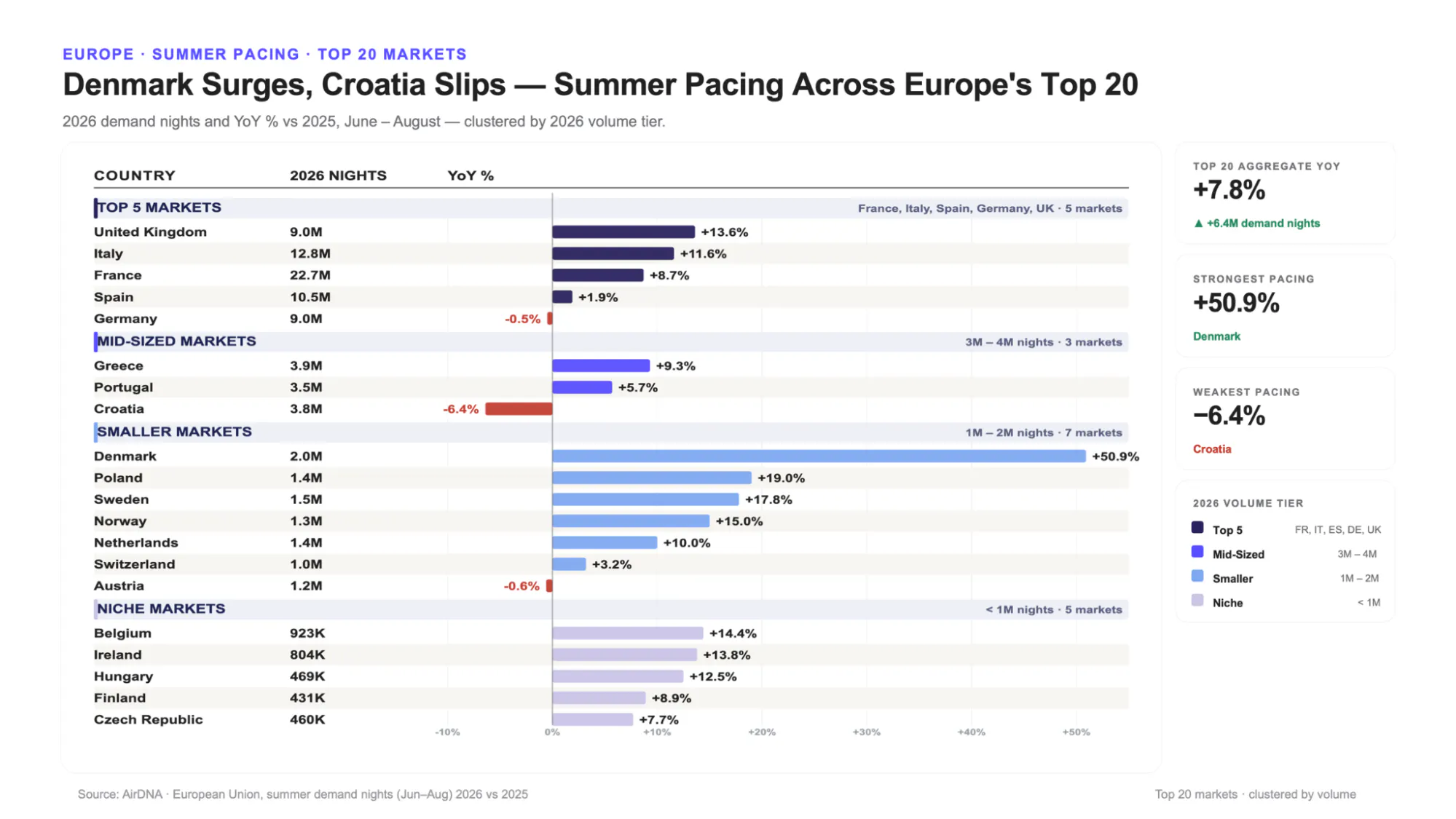
Summer 2026 demand pacing (June–August) across Europe’s top 20 markets remains strong despite geopolitical uncertainty, with the group collectively pacing +7.8% YoY, equivalent to an additional 6.4M demand nights. Seventeen of the 20 markets are currently pacing ahead of last year.
The key trend this summer is the outperformance of Northern European markets relative to traditional Mediterranean destinations.
- Top-volume markets: France remains the largest summer market at 22.7M nights (+8.7%), while Italy (+11.6%) and the United Kingdom (+13.6%) continue to post strong growth. Spain is growing more modestly (+1.9%), suggesting possible saturation or pricing resistance in major coastal markets. Germany remains slightly negative (-0.5%).
- Mediterranean markets: Greece (+9.3%) and Portugal (+5.7%) continue to grow steadily, while Croatia (-6.4%) is the weakest-performing market in the top 20, signaling a cooldown after several years of exceptional post-pandemic growth.
- Northern Europe: Denmark leads all major European markets at +50.9% YoY, followed by Poland (+19.0%), Sweden (+17.8%), and Norway (+15.0%). The Netherlands (+10.0%) also continues to perform strongly, reflecting growing demand for cooler, less-crowded alternatives to Southern Europe.
- Smaller markets: Belgium (+14.4%), Ireland (+13.8%), Hungary (+12.5%), Finland (+8.9%), and the Czech Republic (+7.7%) are all pacing ahead of last year, reinforcing how broad-based summer demand remains across Europe.
Overall, summer demand in 2026 continues to broaden geographically, with travelers increasingly exploring alternatives to traditional Southern European destinations as pricing, crowding, and extreme summer temperatures reshape travel behavior.
Where Summer Travel Costs the Most and Where It Doesn't
Seasonality continues to shape pricing across Europe’s short-term rental market, with some destinations seeing sharp summer ADR premiums while others remain relatively stable year-round.
AirDNA compared summer ADRs (June–August 2025) with ADRs during the rest of the year to identify where travelers pay the largest seasonal premium. Mediterranean destinations lead the rankings, with Greece (+54.9%), Croatia (+37.6%), and Portugal (+36.5%) posting the steepest summer markups. In these markets, shifting a trip outside peak season can reduce accommodation costs significantly.
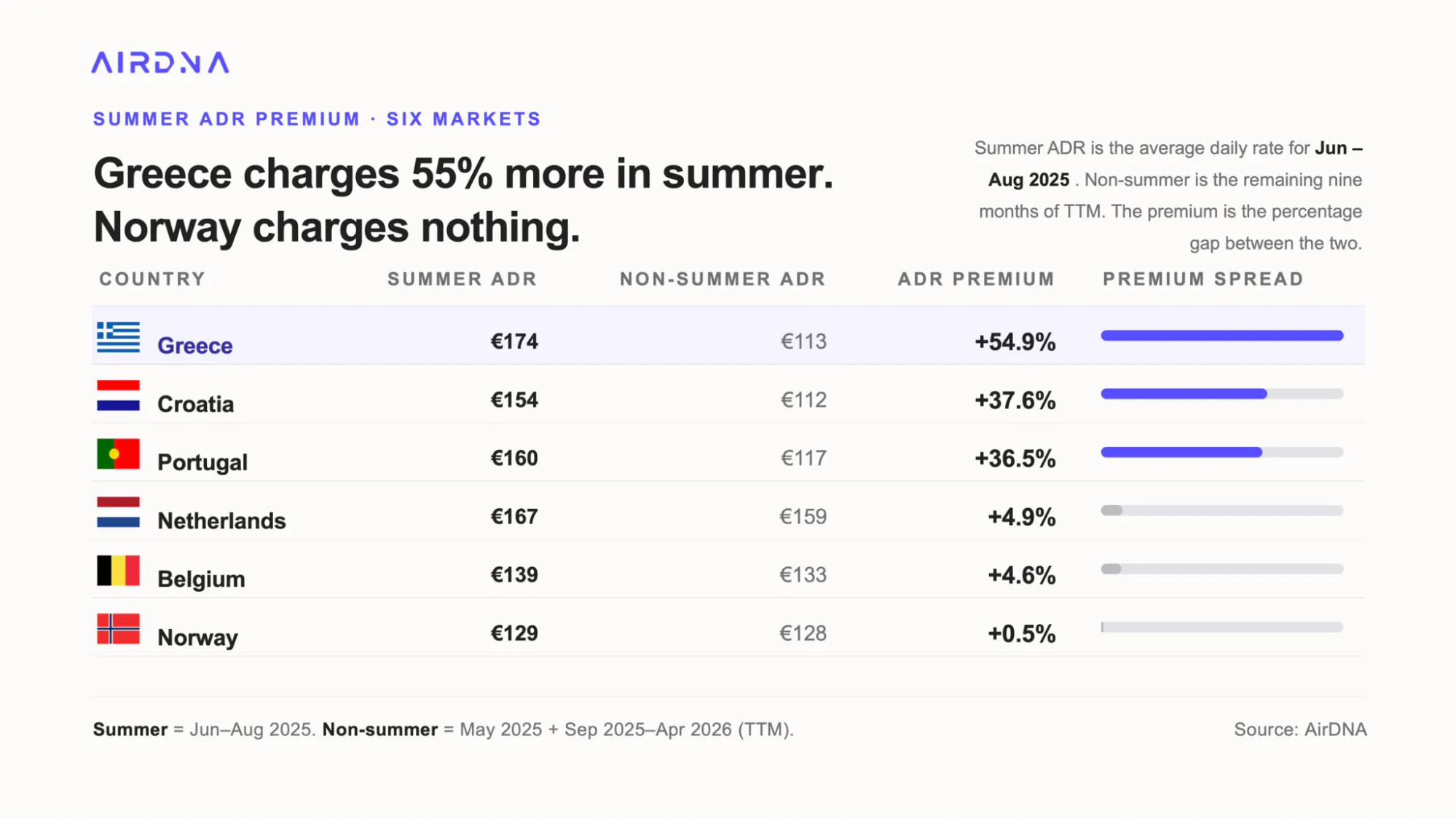
By contrast, countries such as Norway (+0.5%), Belgium (+4.6%), and the Netherlands (+4.9%) show minimal seasonal pricing differences, reflecting more balanced year-round demand.
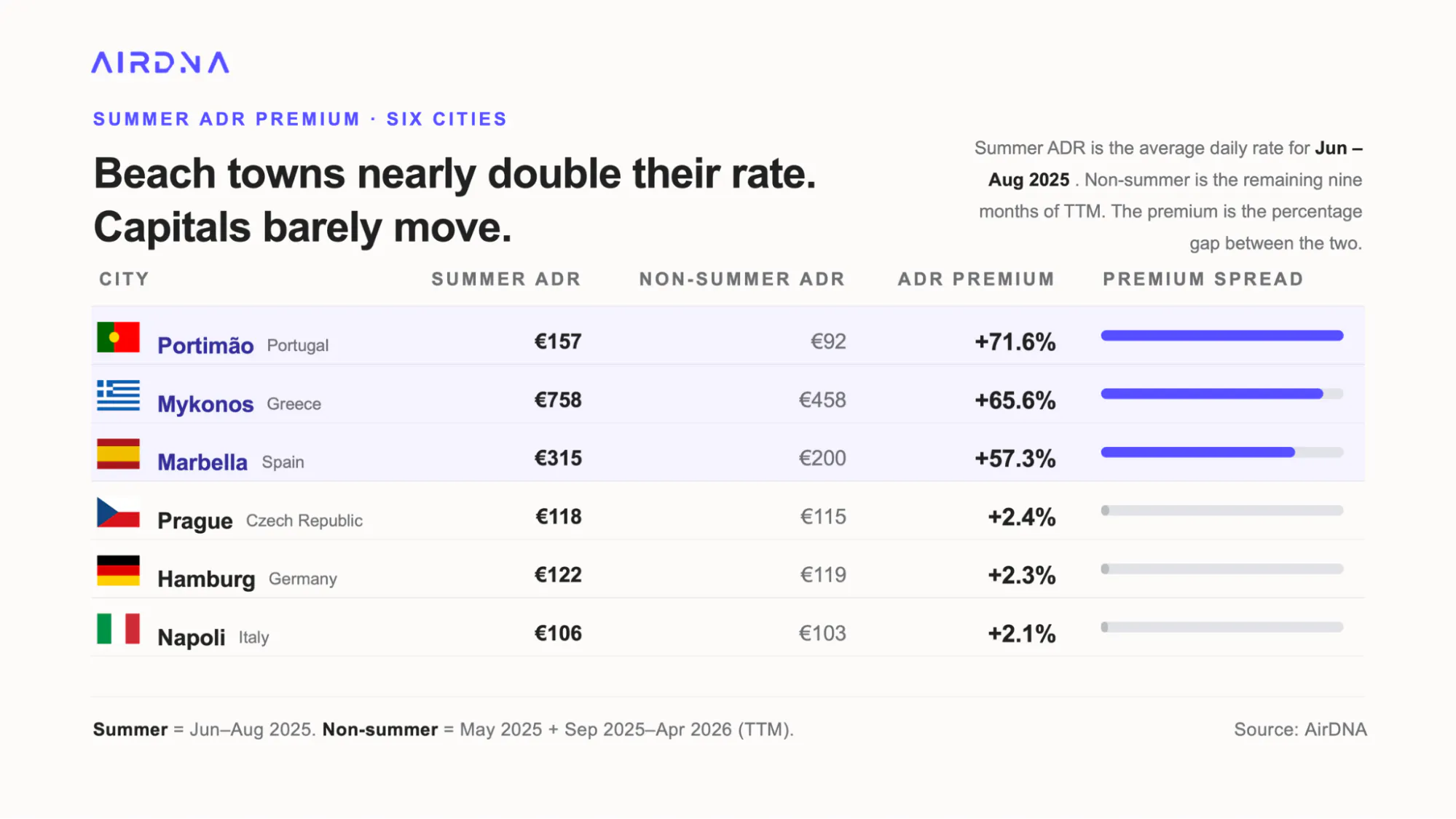
The same pattern appears at the city level. Portimão (+71.6%) on Portugal's Algarve coast sees the biggest summer premium of any major European market, while Mykonos (+65.6%), and Marbella (+57.3%) aren’t far behind. On the flat-rate end, three urban cultural destinations barely move with the seasons: Prague (+2.4%), Hamburg (+2.3%), and Napoli (+2.1%) remain comparatively stable throughout the year, reflecting the steady year-round demand of city-break tourism over weather-driven travel.
Know when (and why) you're empty
AirDNA helps you spot seasonality trends, booking lead times, and local comps—so you can fill your calendar smarter.

Camilo Schmid Rivas
AirDNA Data Analyst
Camilo Schmid Rivas is a Data Scientist at AirDNA who brings a uniquely well-rounded perspective to short-term rental analytics. With a background that spans investment, real estate, and business analysis—including roles at Stayery and Sollers Consulting—Camilo has worn many analyst hats, each sharpening his ability to turn complex data into clear, actionable insights. A graduate of École hôtelière de Lausanne, he now channels his multidisciplinary expertise into uncovering trends that drive smarter STR decisions. In his free time, he enjoys playing tennis or scuba diving in or around Barcelona.

