
Welcome to the 2026 agentic AI landscape, where Google is calmly tying its laces while OpenAI, with its leading consumer chat interface, sprints headfirst into the woods.
Many assume Google must throw its trillion-dollar search business out the window to compete against OpenAI. They’re wrong.
Google doesn’t need to reinvent the wheel; it just needs to ensure OpenAI doesn't outrun it in the race to become your go-to AI travel assistant—while keeping its search cash cow running.
Here is what this means for the future of the travel industry.
The "Video Didn’t Kill the Radio Star" Rule
Tech history is pretty consistent: transformative interfaces tend to layer, not replace the old paradigm. Mobile didn’t kill the desktop, and the web didn't kill offline shopping. It is a mistake to think agentic shopping will wipe out web e-commerce.
Agentic shopping will live alongside the web as a growing new acquisition channel. It’s an evolution of the marketing mix, not an extinction event.
The Power of the AI Orchestrator
The viral success of OpenClaw gave us a glimpse of the future. A true AI agent functions as an orchestrator. It doesn’t do everything itself; it spins up specialized sub-agents to solve specific problems—finding the best boutique hotel in Rome, checking it against your loyalty points and verifying the cancellation policy—then combines those outputs into a finished result.
The user doesn't see the complexity underneath, but simply needs to confirm in WhatsApp the travel booking details before the AI assistant pulls out its agentic credit card for payment. This "orchestration layer" is where the value lies, and it’s why the interface of the future isn't a new revolutionary chatbot or a new AI-first device, but an integration into the daily apps you already use in your smartphone.
OpenAI’s "Spaghetti Strategy"
OpenAI has been frantically throwing AI products at the wall to see what sticks—a "spaghetti strategy" that has left behind a trail of half-baked tools. From GPT plugins to the Atlas browser (its browser market share remains below 1% four months after launch) and the recently sunsetted ChatGPT instant checkout, the company’s consumer-facing e-commerce attempts have been shaky.
Instead, OpenAI is retrenching back to the discovery phase with ChatGPT’s Shopping Research while doubling down on a more lucrative revenue stream through enterprise token consumption. After the massive success of Claude Code as a general-purpose agentic engineering tool, OpenAI is busy expanding its own agentic coding tool called Codex.
Why Google's ecosystem is the ultimate context engine
If an AI agent knows your loyalty numbers, room preferences and budget, it won't just search the web, it will filter the world through that specific context. It remembers that "terrible experience" you had with a specific airline mentioned in an email or the "amazing hidden gem" you starred on Google Maps.
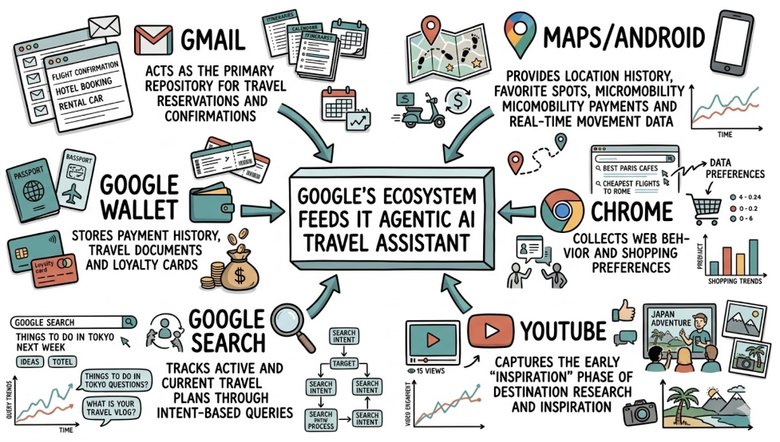
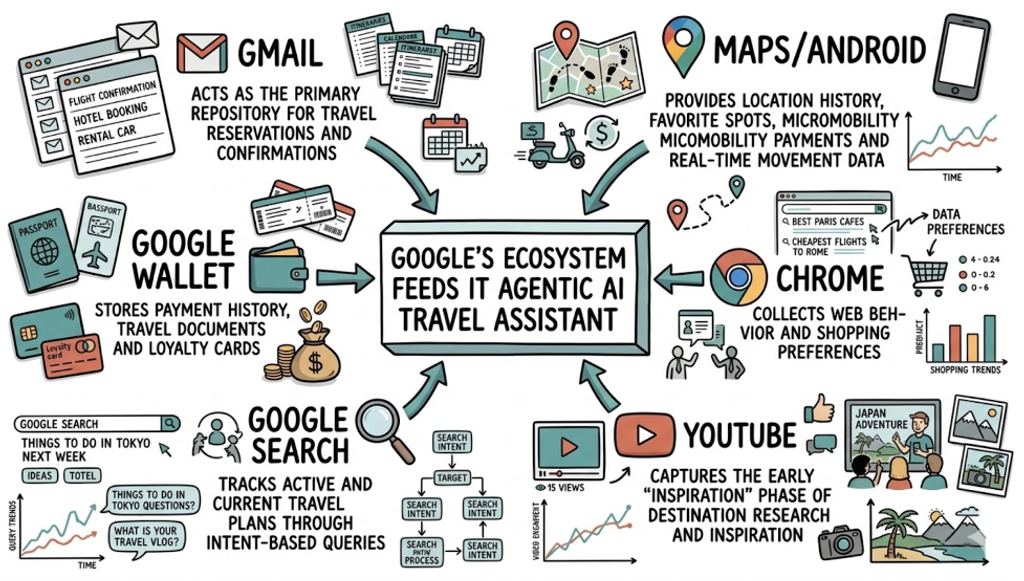
This is where Google’s dominance becomes clear. Every interaction you have in Google´s ecosystem expands the context:
- Gmail: Acts as the primary repository for travel reservations and confirmations
- Maps/Android: Provides location history, favorite spots, micromobility payments and real-time movement data
- Chrome: Collects web behavior and shopping preferences
- YouTube: Captures the early "inspiration" phase of destination research and inspiration
- Google Search: Tracks active and current travel plans through intent-based queries
- Google Wallet: Stores payment history, travel documents and loyalty cards
Google is gradually embedding Gemini into every one of these touchpoints. AI Mode includes conversational trip planning in Canvas and conversational search in Google Maps, while Google’s broader AI ecosystem also supports agentic booking for restaurants and events in the U.S. and a productivity agent connecting your email, calendar and Google. By integrating conversational and agentic capabilities directly into these tools, Google ensures it doesn't just have a better model—it has deeper user data.
Continuing its push forward, the search giant announced in the U.S. the addition of Personal Intelligence across AI Mode in search, the Gemini app and Chrome. The feature can provide tailored shopping suggestions, build travel itineraries and recommend the most suitable airport restaurants based on your departure time, terminal gate and food taste.
The vision of becoming a personal travel assistant has long been the holy grail of major travel companies. The hard truth is that no travel company will ever be able to compete against Google's depth of user knowledge combining search history, shopping habits and physical location.
Is Google finally a Super OTA?
For over a decade, the travel industry has cried wolf about Google becoming an OTA. But as agentic shopping eventually moves to a mainstream habit, will the Google finally become the world’s most powerful travel agency?
Past experiments like "Book on Google" and "Buy on Google," were shuttered after the company realized that owning the transaction is far less lucrative than fueling the competition for it. And no amount of machine learning can prepare the trillion-dollar tech giant for the raw, unpredictable power of a traveler who has been stuck in an airport for twelve hours or just confronted a hotel overbooking during his 3:00 a.m. hotel check in.
Google has no interest in being your travel agent. It spent the last two decades perfecting the art of converting intent signals into sales, and the agentic world is the next frontier. Google will let travel brands handle the messy realities of payments, cancellations, and customer service, while it focuses on ensuring that in an agentic world, it remains the infrastructure through which travel intent is taxed.
Preparing for the agentic era
Travel marketing strategy will gradually move beyond just being "searchable"—successful brands feed Google's context engine positive signals and be "bid-ready" for the moment a Google agent begins to shop on a user's behalf.
Here are three steps to stay ahead of the curve:
Allocate an experimental budget to AI: While you keep optimizing your existing search campaigns, start experimenting with Google's AI-driven ad features like Performance Max (PMax) and AI Max for search. Securing a "foot in the doorstep" now is essential, as these placements are the primary monetization infrastructure for Gemini’s future agentic layer.
Become an "API Company": Sam Altman noted that "Every company is now an API company, whether they want to be or not." Ensure your inventory and all your interactions with customers, followers, suppliers and business partners are easily crawlable and indexable for LLMs. Use Schema.org as the glue that holds structured data together. Success depends on how well your brand sends positive signals for the agent context when making buying decisions
Experiment with Agentic Protocols: Ensuring your tech stack is ready for autonomous e-commerce requires constant assessment and experimentation with emerging agentic protocols.
- Build an MCP server for search and expand into shopping
- Experiment with agentic browser protocols like WebMCP and Cloudflare Markdown
- Shape UCP’s expansion into travel when you can. Despite Google's agentic "Universal Commerce Protocol" not being adapted to travel yet, the industry will certainly become part of its future roadmap. Proactive brands will be able to shape its expansion in travel and enjoy a first mover advantage.
A Final Thought
Google has spent two decades building the context engine that makes this agentic future possible, so even if agentic e-commerce will not kick your current marketing mix out of the house, it will eventually become a relevant channel in your overall marketing tool kit.
The question for brands in Google will no longer be limited to “How do we rank on page one?” or “How do we optimize a landing page for this keyword?” but also: “How do we ensure we are the first brand an AI agent recalls when a traveler asks it to plan and book a summer holiday?”

