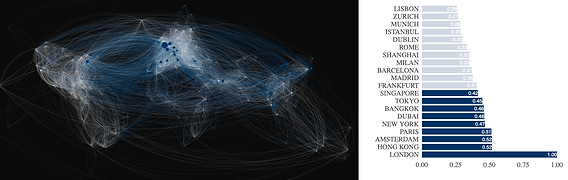
This is the largest and most comprehensive study to date, merging 7.5 million firm‑level records with 30 years of global flight data across 400,000 routes and more than 800 cities. The research applies a new analytical methodology that shows how the quality of global connections – measured through degree, betweenness and eigenvector centrality – play a significant role in shaping where multinational corporations establish subsidiaries.
The study, titled “Air Connectivity Boosts Urban Attractiveness for Global Firms”, was recently published in the Nature Cities journal, and provides valuable guidance for planners and policymakers, highlighting high‑quality air connectivity as a strategic lever for sustaining competitiveness and future‑proofing urban growth.
Key findings include:
- Flight convenience boosted foreign investment as more layovers are associated with fewer subsidiaries being established in a city
- A city’s position within the global air network — not just simply the number of routes it serves — was found to be the strongest predictor of how many foreign subsidiaries it attracted.
- Knowledge‑intensive sectors such as finance, consulting and technology are especially sensitive to air connectivity.
For more information, please refer to the press release attached and appended below. Relevant images and captions can be found here with credits to SMART M3S.
A new landmark study by the Mens, Manus & Machina (M3S) interdisciplinary research group of the Singapore‑MIT Alliance for Research &Technology (SMART), alongside collaborators from Massachusetts Institute of Technology (MIT) and the National University of Singapore (NUS), has identified a strong statistical association between global air connectivity and patterns of where multinational corporations (MNCs) invest and set up subsidiaries.
This is the largest and most comprehensive study to date, merging 7.5 million firm‑level records with 30 years of global flight data across 400,000 routes and more than 800 cities. The research applies a new analytical methodology that shows how the quality of global connections – measured through degree, betweenness and eigenvector centrality – play a significant role in shaping where multinational corporations establish subsidiaries.
The study, titled “Air Connectivity Boosts Urban Attractiveness for Global Firms”, was recently published in the Nature Cities journal, and provides valuable guidance for planners and policymakers, highlighting high‑quality air connectivity as a strategic lever for sustaining competitiveness and future‑proofing urban growth.
Key findings include:
- Flight convenience boosted foreign investment as more layovers are associated with fewer subsidiaries being established in a city
- A city’s position within the global air network — not just simply the number of routes it serves — was found to be the strongest predictor of how many foreign subsidiaries it attracted.
- Knowledge‑intensive sectors such as finance, consulting and technology are especially sensitive to air connectivity.
For more information, please refer to the press release attached and appended below. Relevant images and captions can be found here with credits to SMART M3S.

