 Key Takeaways

- Summer demand remains strong, with July, August, and September all pacing ahead of last year as travelers shift trips later into the season.
- The coolcation trend continues to reshape travel, boosting demand across Northern Europe while traditional Mediterranean destinations soften.
- Supply growth slowed to just 1.3%, its weakest pace in years, as Europe’s short-term rental market continues to mature.
In June, Europe’s short-term rental market continued to cool year over year, even as pricing strengthened. Supply growth slowed to just 1.3%, its most muted pace since April 2022, while demand nights fell 3.3%. With listings still outpacing bookings, occupancy edged down to 60.3%, but hosts continued to show pricing power, pushing ADR up 7.5% to €150.
The outlook for the rest of summer is far more encouraging. July bookings are pacing 5.3% ahead of last year, August is up 5.4%, and September is leading the way at 9.6%. Rather than pulling back, travelers appear to be shifting trips out of a softer June and into the peak and shoulder seasons. They’re also embracing the coolcation trend. As heat waves push temperatures well above seasonal norms, demand is accelerating in northern and Nordic destinations while traditional Mediterranean hotspots such as Spain and Croatia soften.
At a Glance: June 2026 STR Performance in Europe
- Available listings reached 4.07 million, an increase of 1.3% YoY
- Demand nights declined 3.3% YoY to a total of 46.1 million
- Average daily rates (ADR) increased 7.5% YoY to €150.1
- Average occupancy rate fell to 60.3%, down 1.6% YoY
- Revenue per Available Rental Night (RevPAR) increased 4.8% YoY to €90.5
| Metric | June 2025 | June 2026 | YoY Change |
|---|---|---|---|
| Available Listings | 4.02 Million | 4.07 Million | 1.3% |
| Demand Nights | 47.71 Million | 46.13 Million | -3.3% |
| ADR | €139.51 | €150.05 | 7.5% |
| Occupancy | 61.9% | 60.3% | -1.6% |
| RevPAR | €86.37 | €90.52 | 4.8% |
June looks more like a reshuffle than a slowdown. Softer occupancy masked a market that continues to show underlying resilience, with hosts maintaining pricing power and forward bookings pointing to a much stronger second half of the summer. Rather than signaling weaker travel demand, June increasingly looks like a month travelers chose to skip in favor of later departures.
The State of the European Economy
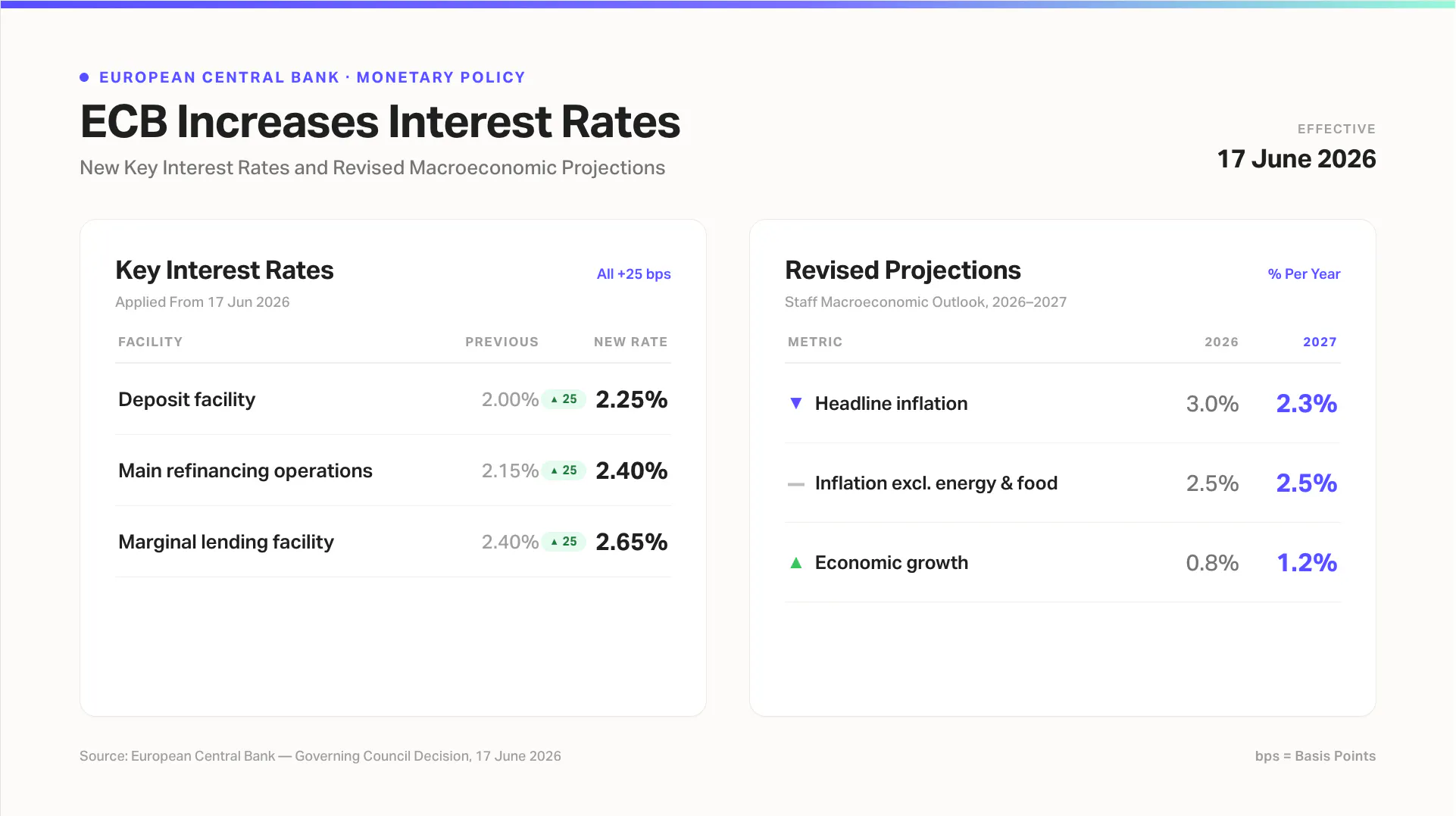
Inflation across the Euro area eased to 2.8% in June, down from 3.2% in May, but remained well above the European Central Bank’s (ECB) 2% target. In response, the ECB raised interest rates by 25 basis points on June 17, ending a year of stable rates. With the conflict in the Middle East pushing up energy prices and adding inflationary pressure, the decision came as little surprise.
The ECB expects headline inflation to average 3.0% in 2026 before easing to 2.3% in 2027, while economic growth is forecast to improve modestly from 0.8% in 2026 to 1.2% in 2027.
The broader picture is mixed. Economic sentiment improved to its highest level since the conflict in the Middle East began, but hiring expectations fell to their lowest point since November 2020, pointing to a softening labor market.
So far, none of that has derailed travel demand. Despite higher borrowing costs and more expensive travel, bookings continue to pace ahead of last year, with July and August up 5.3% and 5.4%, while September is leading the way at 9.6%. For now, Europeans appear to be adjusting when they travel rather than whether they travel.
How Is Your STR performing?
Your vacation rental may be amazing, but is it better than your competition? Connect your Airbnb listing to AirDNA to see its Booking Performance Score.
Steady Supply Growth as Summer Approaches
Available listing growth in Europe continued to slow through June, with listings reaching 4.1 million, up just 1.3% year over year. That’s down from 2.1% in May and marks the slowest pace of supply growth since April 2022.
This continues a trend that has been building over the past several years. Following the rapid expansion seen in 2024, year-over-year growth has become more muted as the European market matures and comparisons become tougher. Supply growth is now more in line with mature markets such as the United States, which recorded 2% growth in June.
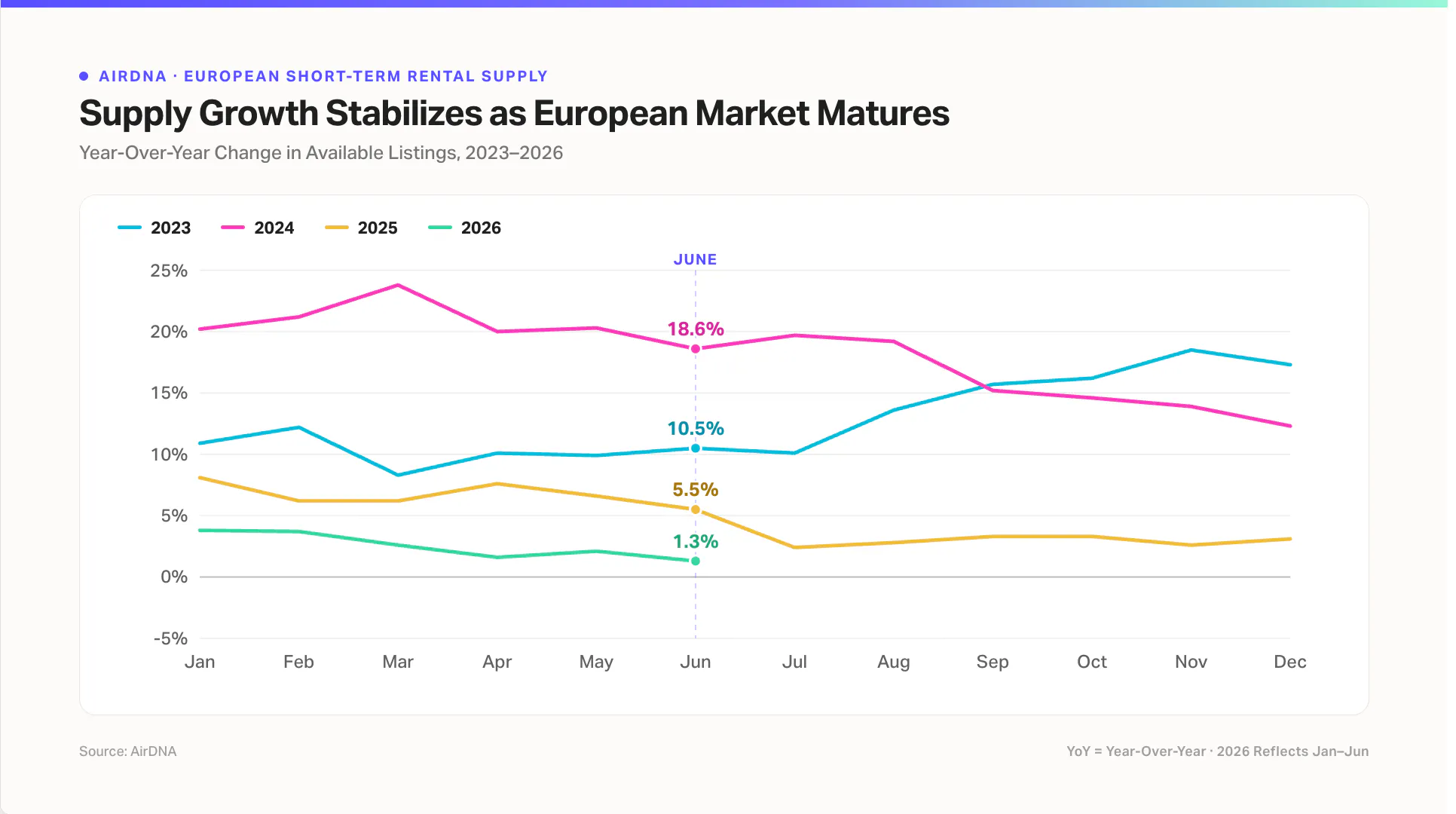
A higher comparison base is only part of the story. Europe also recorded its lowest number of new listings for the month of June in four years. As the table below shows, 140,000 new listings entered the market in June 2026, compared with 150,000 in 2025 and more than 180,000 in both 2023 and 2024. The three-month moving average also slowed to 7.1%, reinforcing the broader trend toward slower supply growth.
| Period | New Listings | % Change |
|---|---|---|
| June 2026 | 140,000 | - |
| June 2025 | 150,000 | -6.7% |
| June 2024 | 178,000 | -21.3% |
| June 2023 | 182,000 | -23.1% |
Supply growth across Europe’s top 20 markets remained mixed. The five largest markets grew just 0.7% year over year, well below the wider European pace, largely because available listings in Spain fell 12.5% following the delisting efforts that began in the second half of 2025. Excluding Spain, the region’s largest markets continued to grow steadily, led by the United Kingdom (+3.6%), Italy (+3.4%), France (+2.9%), and Germany (+2.7%).
Among markets with more than 75,000 listings, Croatia and Greece continued to contract, while Portugal, Poland, and Denmark posted healthy growth, with Poland leading at 7.2%. Croatia’s contraction reflects a longer-running slowdown following softer demand, while Greece has continued to shrink since the October 2025 regulations aimed at improving market quality removed lower-quality listings.
Mid-sized and emerging markets continued to drive Europe’s supply growth. Markets with more than 50,000 listings expanded 4.6% year over year, led by Sweden (+8.3%) and Norway (+8.0%). Smaller markets also grew strongly, with Finland (+11.3%) and the Czech Republic (+8.9%) leading the way, while more mature markets such as Switzerland and the Netherlands continued to grow at a gentler pace.

