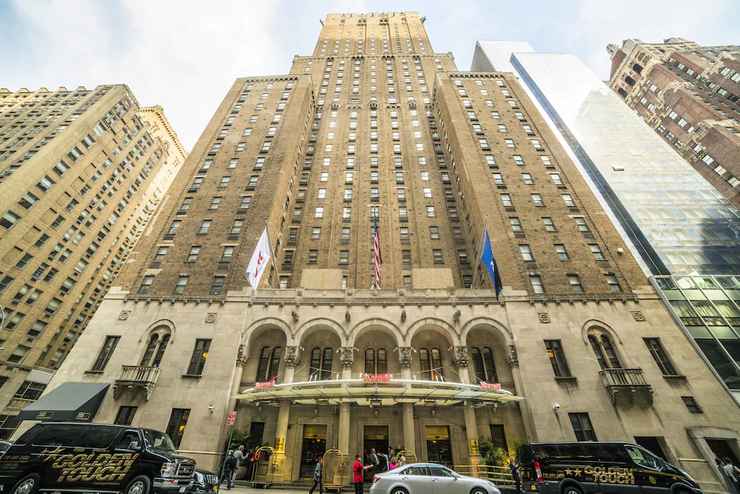
Critics agreed that its picturesque 35-story façade and unusual setback design pointed the way of the future for the skyscraper.
The Shelton was built by the architecturally ambitious developer James T. Lee, who was also responsible for two luxurious apartment houses: 998 Fifth Avenue of 1912 and 740 Park Avenue of 1930.
He was the grandfather of Jacqueline Kennedy Onassis, born Jacqueline Lee Bouvier.
Mr. Lee’s vision was a 1,200-room bachelor hotel with club-type characteristics: a swimming pool, squash courts, billiard rooms, a solarium and an infirmary. The New York World in 1923 claimed that the Shelton would be the tallest residential building in the world.

The architect, Arthur Loomis Harmon, covered the mass with irregular yellow-tan brick, roughened as if centuries old, and drew from Romanesque, Byzantine, early Christian, Lombard and other styles. But critics were more impressed that it recalled “no definite architectural style of the past,” as the artist Hugh Ferriss put it in The Christian Science Monitor in 1923.
The Shelton was one of the first buildings to take its form from a 1916 zoning law that required setbacks at certain heights to ensure light and air to the street. That made it quite different from the tall boxy hotels designed before the zoning change, like the 1919 Hotel Pennsylvania, opposite Pennsylvania Station.
“A stately, breath-taking building,” said Helen Bullitt Lowry and William Carter Halbert in The New York Times in 1924. The critic Lewis Mumford, traditionally stingy with praise, called it “buoyant, mobile, serene, like a Zeppelin under a clear sky” in Commonweal magazine in 1926.
The visionary design has its limits, however, and Mr. Harmon’s interiors appear to have been little different from other giant hotels of the period: great paneled lounges, a dining room with a beamed ceiling and long groin-vaulted hallways. A third of the rooms had shared baths, which must have posed complications in late 1924 when the Shelton reversed its men-only policy. A high gallery ran around the basement pool, which was decorated with polychromed tile.
From 1925 to 1929, Georgia O’Keeffe lived on the 30th floor of the Shelton Hotel with her husband, the photographer Alfred Stieglitz. With the possible exception of the Hotel Chelsea, it’s hard to think of another New York City hotel that’s had such a profound effect on an artist, especially a hotel you’ve probably never heard of.
Towering over Lexington Avenue between 48th and 49th Streets, the 31-story, 1,200-room Shelton Hotel was hailed as the tallest skyscraper in the world when it opened in 1923. Not only was it tall, it was a rarity—an elegant residential hotel for men with a bowling alley, billiard tables, squash courts, a barbershop and a swimming pool.
What was never in doubt was the building’s architectural significance. With a tasteful two-story limestone base and three brick setbacks stepping up to a central tower, the Shelton was groundbreaking. Critics deemed it the first building to successfully embody 1916 zoning requirements that prescribed setbacks to keep skyscrapers from becoming hulking eyesores.
The Empire State Building is just one of the buildings Shelton influenced. As late as 1977, New York Times architecture critic Ada Louse Huxtable declared the hotel a “landmark New York skyscraper.”
Tags: Shelton Hotel at Lexington Avenue, New York, New York Marriott East Side

