 European Review March 2026: ADR Jumps, as Supply Growth Accelerates
Key Takeaways
- Supply continued its upward trend, with available listings significantly exceeding demand and driving occupancy declines across the continent. ADR jumped by 8.2%, offsetting some of the imbalance’s impact on RevPAR, with most European nations recording year-over-year gains.
- Summer pacing remains strong despite rising inflation risks and higher overseas travel costs tied to the Middle East conflict.
- Average length of stay continues to decline across all price tiers, suggesting travelers are booking shorter trips more frequently amid ongoing uncertainty.
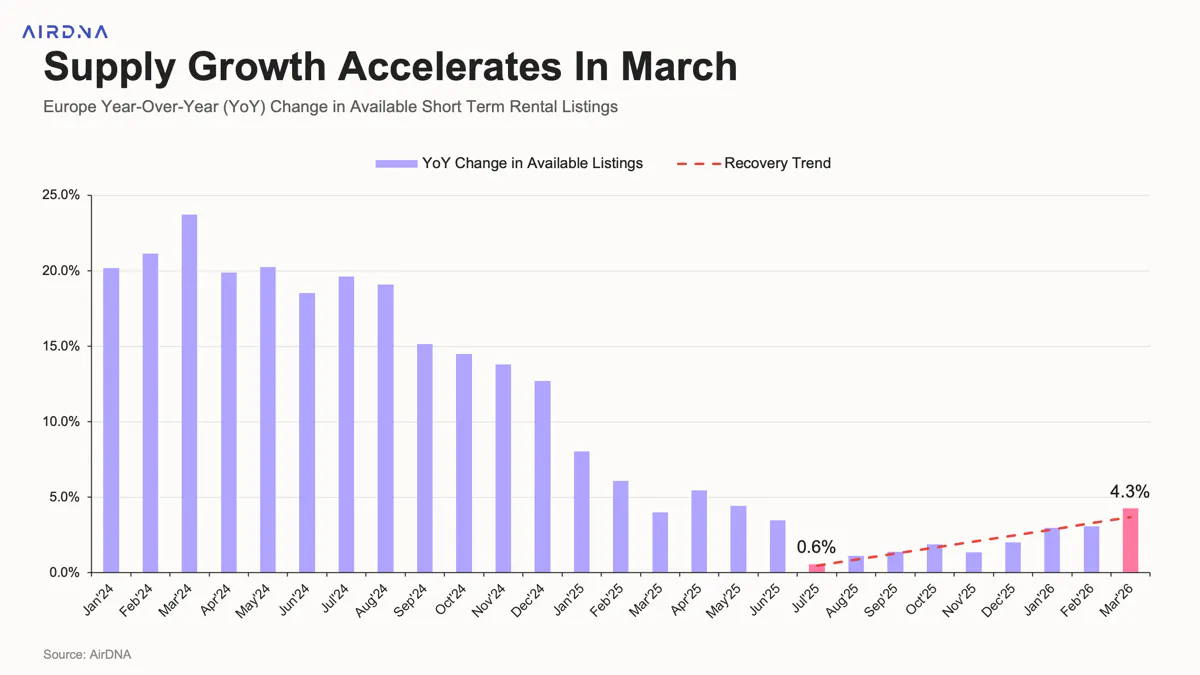
Supply increased steadily by 4.3% in March, while demand declined, pushing occupancy down by 2.5%. Supply growth has accelerated significantly from its July 2025 low of 0.6% YoY. Although demand nights continue to decline, summer pacing remains strong, with demand for June through September up 8.7%. All price tiers are pacing well, with budget and economy listings seeing the largest occupancy gains.
At the same time, traveler behavior continues to shift, with average length of stay declining across all price tiers. This suggests that travelers are opting for shorter, more frequent trips as uncertainty persists.
At a Glance: March 2026 STR Performance in Europe
- Available listings reached 3.48 million, an increase of 4.3% YoY
- Demand Nights declined by 3.5% YoY to a Total of 27.9 million
- Average daily rates (ADR) jumped by 8.2% YoY to €123.9
- Average occupancy rate declined to 52.2%, down 2.5% YoY
- Revenue per Available Rental Night (RevPAR) increased by 5.6% YoY to €64.6
March marked another month of acceleration in supply growth, with available listings up 4.3% year-over-year to 3.48 million listings. As supply increased and demand declined for a seventh straight month, by 3.5% YoY, occupancy fell 2.5%. Of Europe’s top 20 nations, 13 saw occupancy decline. On a positive note, ADR jumped significantly after 11 months of flat or negative growth, rising 8.2%. The rise was aided by strong ADR gains in all of Europe’s Top 5 nations. The increase in ADR ultimately drove RevPAR gains, translating into a 5.6% jump to 64.6€.
The State of the European Economy
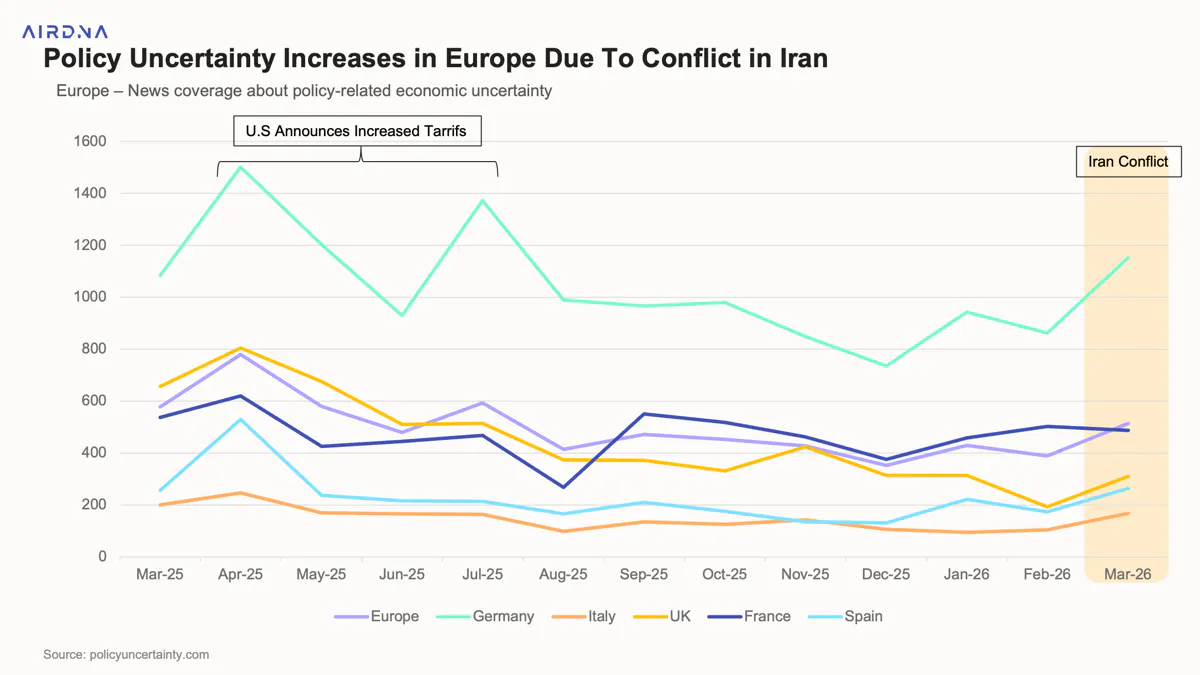
With ongoing conflicts in the Middle East, the Strait of Hormuz remaining closed, and oil prices remaining high, policy uncertainty in Europe has once again increased. The European Economic Policy Uncertainty Index tracks monthly policy-related uncertainty by counting newspaper articles that mention uncertainty, the economy, and policy-relevant terms across European nations. In the graph below, we can see the impact of the Iranian conflict on policy uncertainty, with the index rising in all major European countries except France. Uncertainty in Germany is approaching its 2025 peaks, the result of the U.S.-announced “Liberation Day” tariffs.
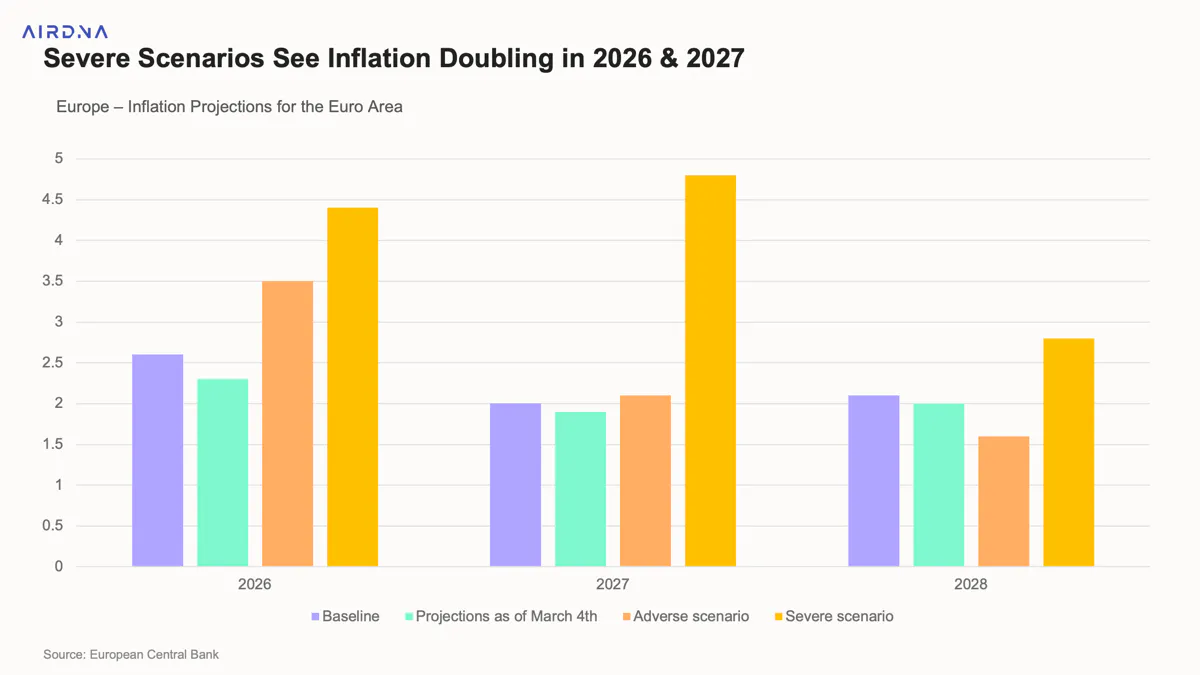
With restricted oil flows from the Middle East continuing to push up energy prices, the European Central Bank has revised its inflation forecasts upward for the current and upcoming years. The ECB expects inflation to increase to 3.1% in Q2 before leveling out at 2.8% in Q3, above the medium-term target of 2% and likely motivating an increase in interest rates later in the year.
As energy and fuel costs rise, affecting long-distance travel, it is important to note that a large share of European tourism demand remains domestic. According to Eurostat data, 40% of total demand is domestic within the European Union, with some countries exhibiting even higher shares. Looking specifically at guest origin data for 2025 from STR, sourced from AirDNA, the following countries stand out for a high proportion of domestic demand:
- Germany 55%
- United Kingdom 66%
- France 67%
With this relatively high domestic demand in Europe and rising prices for long-distance travel, we may see a shift in European travelers’ behavior, with demand moving inward and staying within Europe, offsetting declines from conflicts in the Middle East.
How Is Your STR performing?
Your vacation rental may be amazing, but is it better than your competition? Connect your Airbnb listing to AirDNA to see its Booking Performance Score.
New Listings See Year-Over-Year Growth
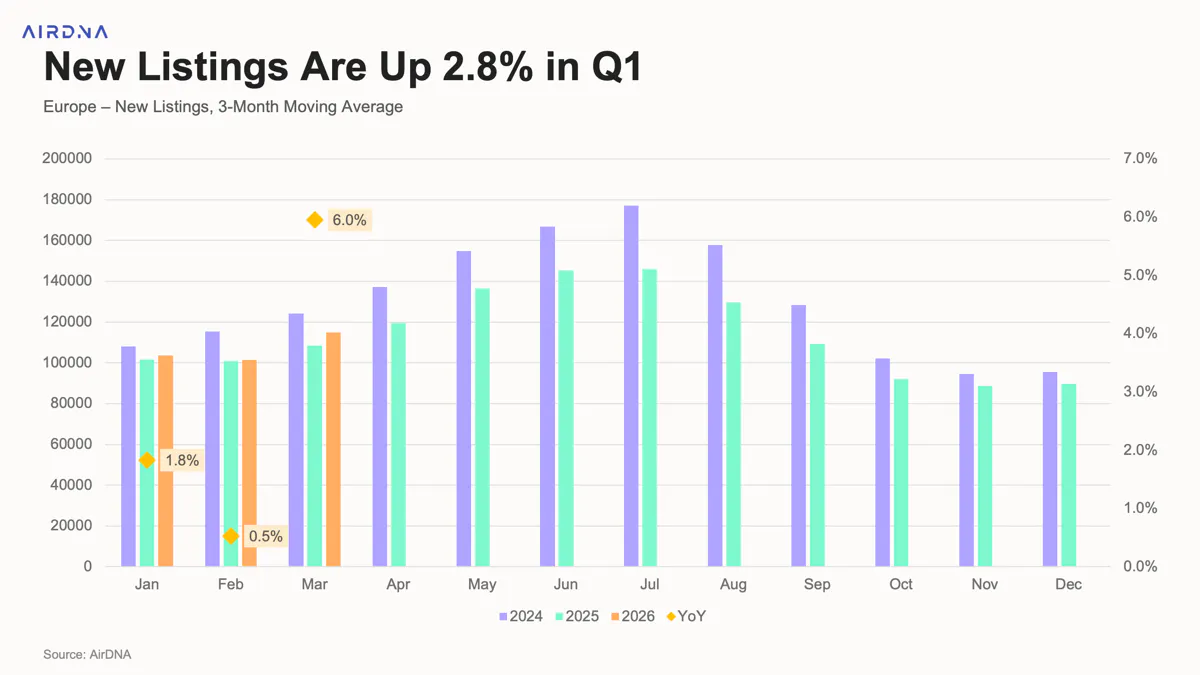
Properties entering the market for the first time are tracked as new listings. These had been on the decline in 2025 after a significant expansion in 2024, which slowed overall supply growth. In 2026, both January and February saw minor year-over-year increases in new listings, followed by a substantial gain in March. The three-month moving average is now up 6% over 2025 and is just 9,000 units shy of the 2024 highs (-7.5% vs. Q1 2024). The strong rebound in the three-month moving average of new listings has driven Q1 new listings growth to the previously mentioned 6%, compared to a 12.7% YoY decline in Q1 2025.
The increases in new listings were mixed across Europe’s top 20 nations, with significant gains seen in Denmark, where new listings for March more than doubled from 2,000 in 2025 to 4,500 in 2026. Other countries that stood out include Germany, with a 27% year-over-year increase, the United Kingdom, with a 22% increase in new listings, and France, which saw a 9.5% gain. On the other hand, Spain stood out with a decrease of 4,500 listings in March 2026, reducing new listings from 12,500 in March 2025 to 8,000 in March 2026, as regulations hampered the entry of new supply.
Demand Nights & Nights Booked See Decline Over 2025 but Gains Over 2024
Nights Booked, which include reservations made during the reporting month for stays in the current or future months, have declined for the seventh straight month since September 2025 and posted their largest drop of -8.3% YoY, marking the biggest decline since February 2021, when Nights Booked fell by -22.3%. Although the decline is significant compared to 2025, Nights Booked in March remain flat versus 2024. Looking at demand nights, the negative trend continues, with March 2026 marking the sixth consecutive month of YoY declines, as demand nights fell by -3.5%.
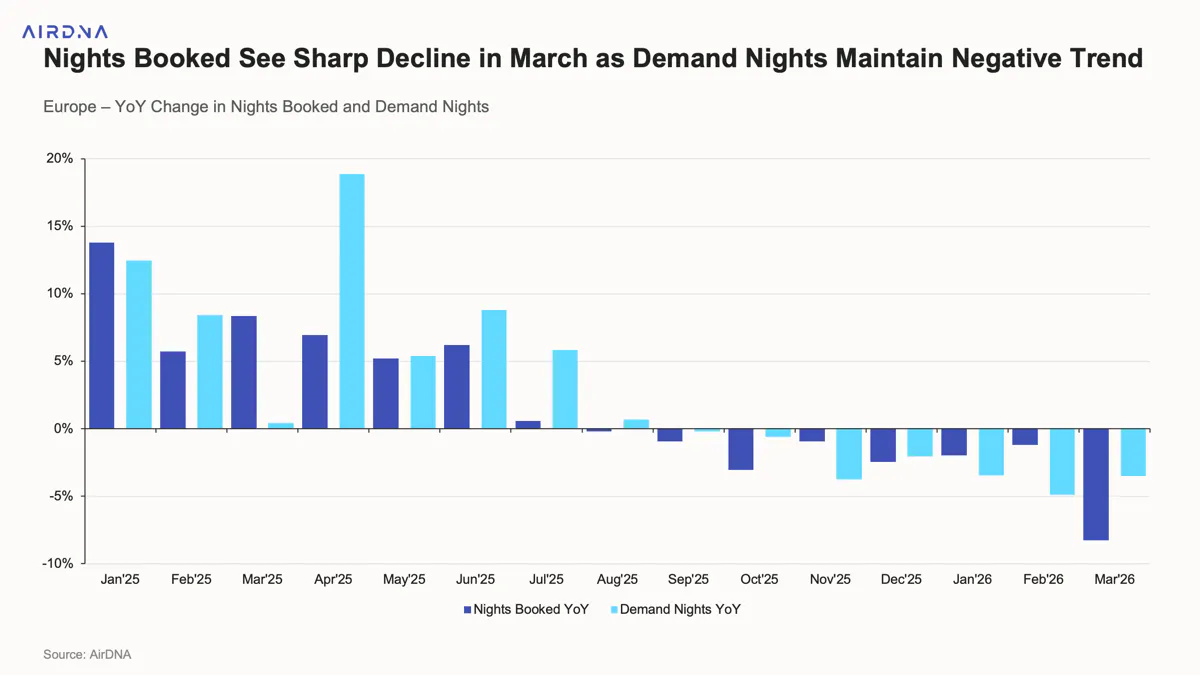
The quarter-over-quarter comparison is less dramatic, with both Nights Booked and Demand Nights decreasing by only -3.9% in Q1 2026 compared to Q1 2025. Looking specifically at demand nights, February drove much of the decline, while overall demand nights increased by 2.4% in Q1 compared to 2024. Nights Booked followed a similar pattern, with the largest drop occurring in March (-8.3%), although they increased by 5.1% in Q1 compared to 2024.
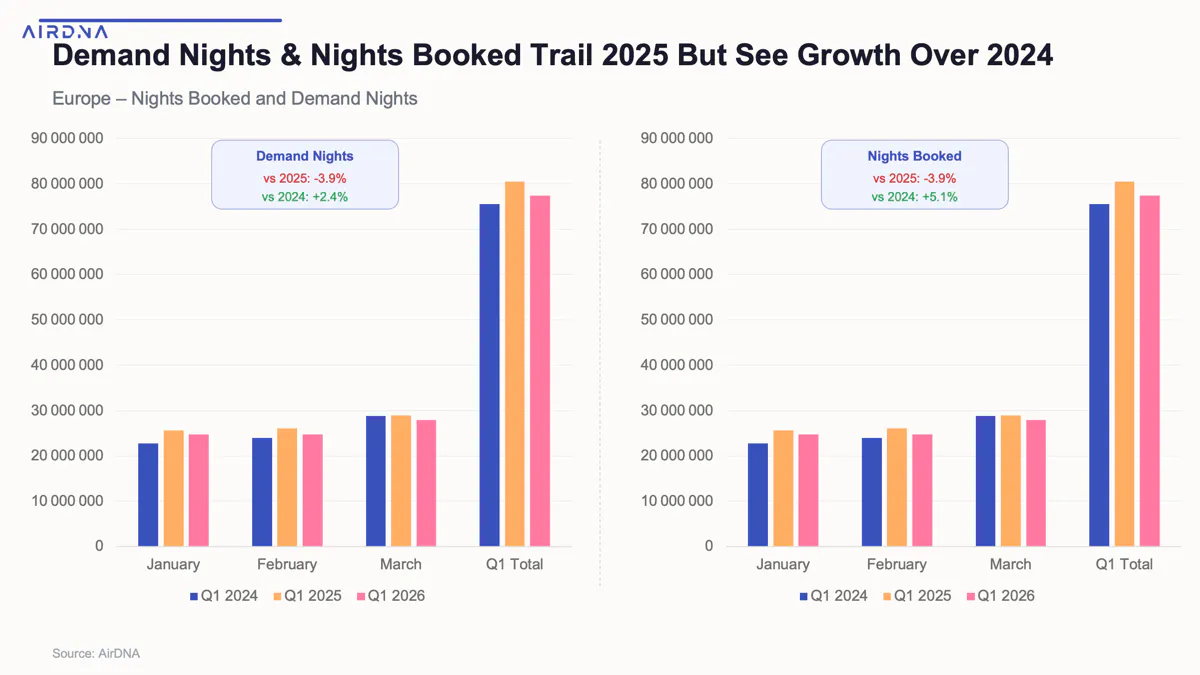
At the same time, both demand nights and Nights Booked are increasing compared to 2024, making 2025 look increasingly like a year of overperformance. This higher baseline creates a more negative outlook for the European market in 2026 than the underlying data suggests. While the decline in Nights Booked for March is significant and likely reflects the impact of the conflict in the Middle East reducing consumer spending, the comparison with 2024 offers a more realistic view of a mature market experiencing modest decline after a strong 2025 performance.
Supply Continues Accelerating in March
Available listing growth in Europe continued its recovery from a low of 0.6% YoY in July 2025 to 4.3%, accelerating steadily over the last nine months. Growth in new listings, now up 6% YoY, has pushed total available listings to 3.48 million, an increase of 150,000 listings compared to February and 140,000 compared to 2025.
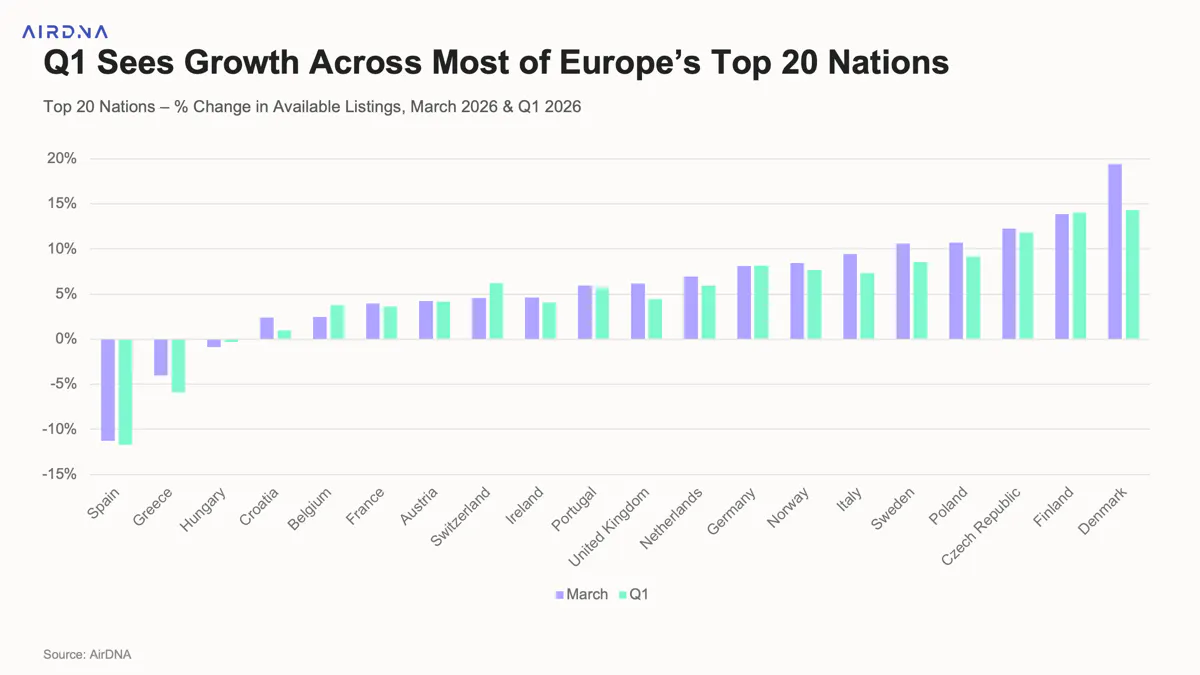
Northern and eastern European countries continued to drive growth for a third consecutive month, recording the highest year-over-year gains. Denmark, Finland, and the Czech Republic ranked among the fastest-growing countries again in March, showing strong market expansion in Q1. Other notable countries include Germany (8.2%), Italy (7.3%), the United Kingdom (4.4%), and France (3.6%), with four of Europe’s top five countries experiencing significant growth in Q1 and adding 100,000 available listings across January, February, and March.
Spain stands out as the exception, with a year-over-year decline of 11.3% in March and 11.7% in Q1. The Spanish market lost more than 40,000 listings as tight regulations
Occupancy Declines in Most Nations as Supply Growth Accelerates
As demand declined for another month (-3.5% YoY) and available listings continued to accelerate (4.3%), occupancy in Europe fell by 2.5% year over year, bringing March occupancy to 52.5%. This trend extends beyond March. With demand declining throughout Q1 while available listing growth accelerated, total occupancy in Europe dropped to 49.8% for the quarter, a 3.4% YoY decline from 51.6% in Q1 2025.
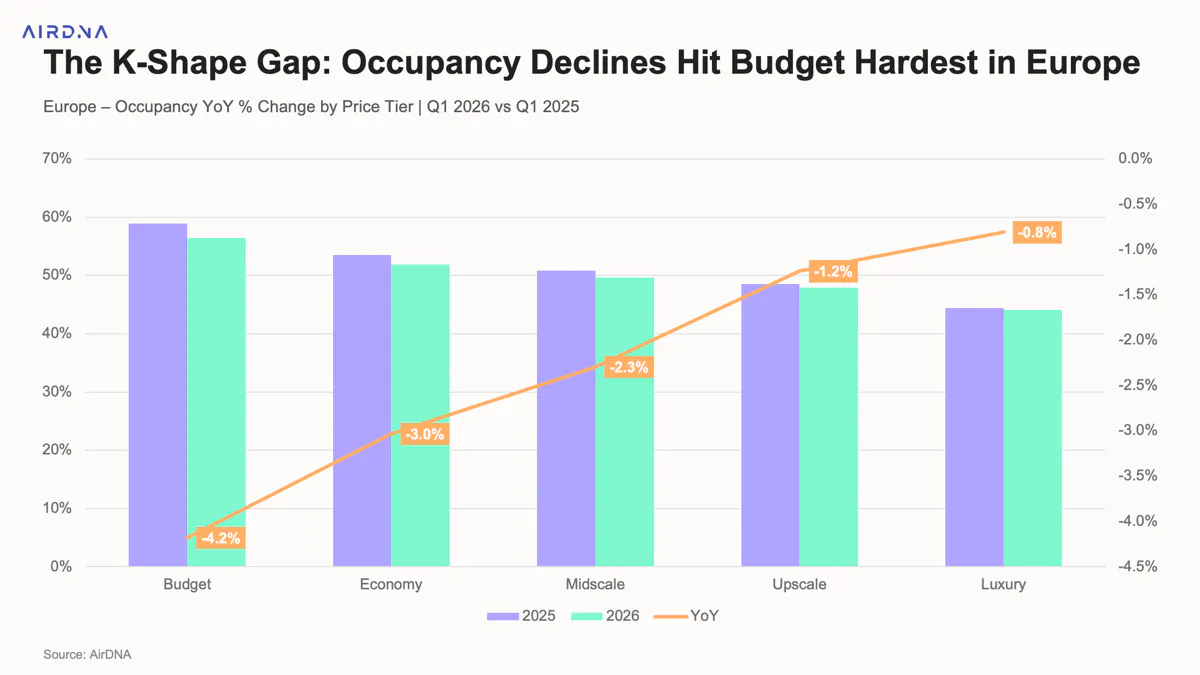
The K-shaped economy has directly influenced how the short-term rental market responds to inflation expectations. In the graph below, we can see occupancy in Q1 by price tier in 2025 and 2026, along with their respective YoY changes. The segment most sensitive to inflation and uncertainty experienced the largest decline in occupancy, with budget listings dropping 4.2% YoY. In contrast, listings serving higher-earning travelers, who are less likely to cut spending, saw only a modest decline, with luxury occupancy down 0.8% YoY in Q1.
Unlike February, when 19 out of 20 top countries saw occupancy declines, March showed a more mixed picture, with occupancy rising in 6 markets, holding steady in 1, and declining in 13. Denmark stood out as the top performer, with occupancy increasing by 5% YoY despite a slight drop in demand nights (-1%) and a significant 19% rise in supply. A 5.9% decrease in active listing nights drove this increase, indicating that much of the new supply is preparing for the summer season. Ireland followed a similar pattern, with occupancy rising by 2% even though available listings grew faster than demand.
At the other end of the spectrum, Switzerland recorded the sharpest occupancy decline (-11%), driven by a 9% drop in demand nights alongside a 5% increase in available listings. Austria (-8%) followed a similar pattern, with demand falling 9% while supply grew by 4%. Similar imbalances appeared in Italy (-4.5%), Finland (-4.1%), and Poland (-1.5%), where supply outpaced demand and pushed occupancy lower.
Spain presented a notable case. Despite an 11% contraction in supply and a 12% drop in demand, occupancy edged up by 1%, as active listing nights also declined, allowing occupancy to increase even as demand fell faster than available listings. The Czech Republic (+1%) and Hungary (+1%) also posted marginal occupancy gains through different mechanisms: the Czech Republic saw strong demand growth of 13% against 12% more supply, while Hungary experienced a slight supply contraction (-1%) that offset a 3% demand decline.
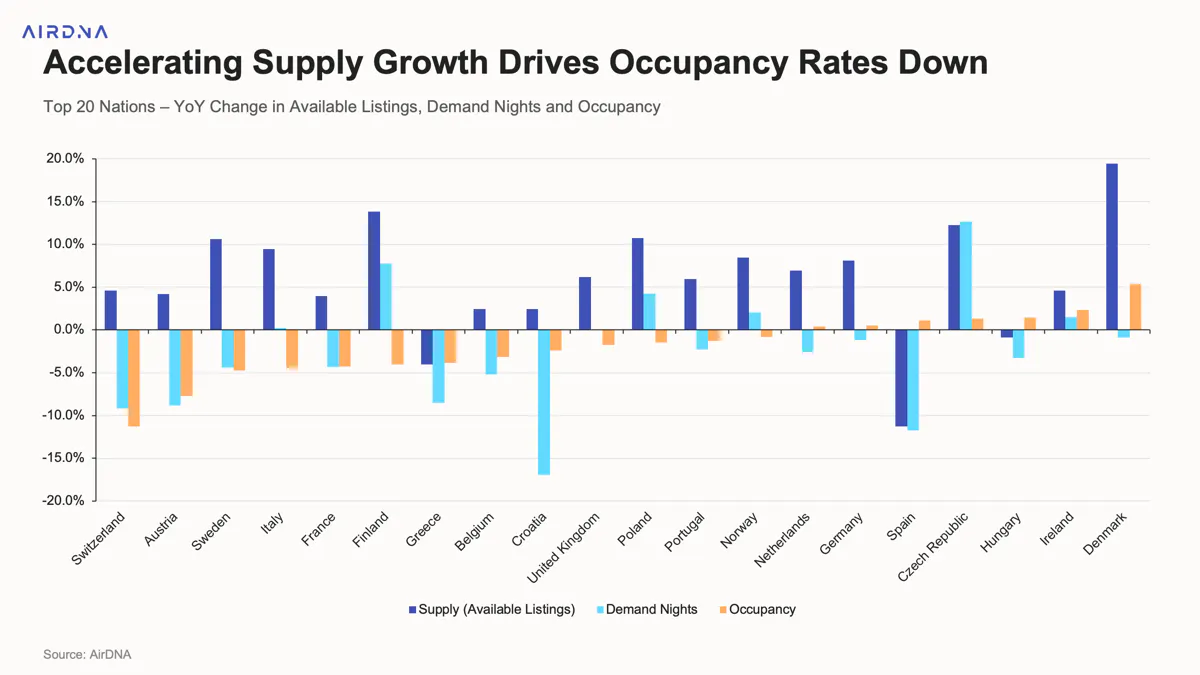
Overall, occupancy continues to decline across Europe as supply expands despite weaker demand. The market appears to be preparing for a strong summer, but it remains uncertain whether additional supply will be fully absorbed, even with summer demand (June–September) already up 8.7% compared to 2025. With more European travelers potentially choosing domestic travel as overseas costs rise, this shift could help offset some of the imbalance.
Research Airbnb Markets
Gain insights into the revenue and occupancy trends in your market.
ADR Recovers As RRI Continues Growing
Average Daily Rates in Europe rebounded strongly after six straight months of decline, marking the largest year-over-year increase since December 2023 and reaching €123.9 (+8.2%). The strong recovery in March pushed Q1 ADR from €117.2 in 2025 to €120.3 in 2026, a 2.6% increase. Meanwhile, the Repeat Rent Index (RRI), which tracks pricing changes among existing operators and excludes the impact of new listings, continued its strong growth, reaching 10.8%, the highest since October 2023, when RRI grew by 11.9% YoY.
Stricter regulations across Europe, including in Spain, Italy, and Greece, along with upcoming EU-wide short-term rental rules aimed at improving data transparency, appear to have slowed the entry of lower-priced properties that previously pushed ADR downward. As a result, ADR now aligns more closely with RRI, suggesting that higher-quality supply entering the market is better matched to existing listings, while established operators retain pricing power.
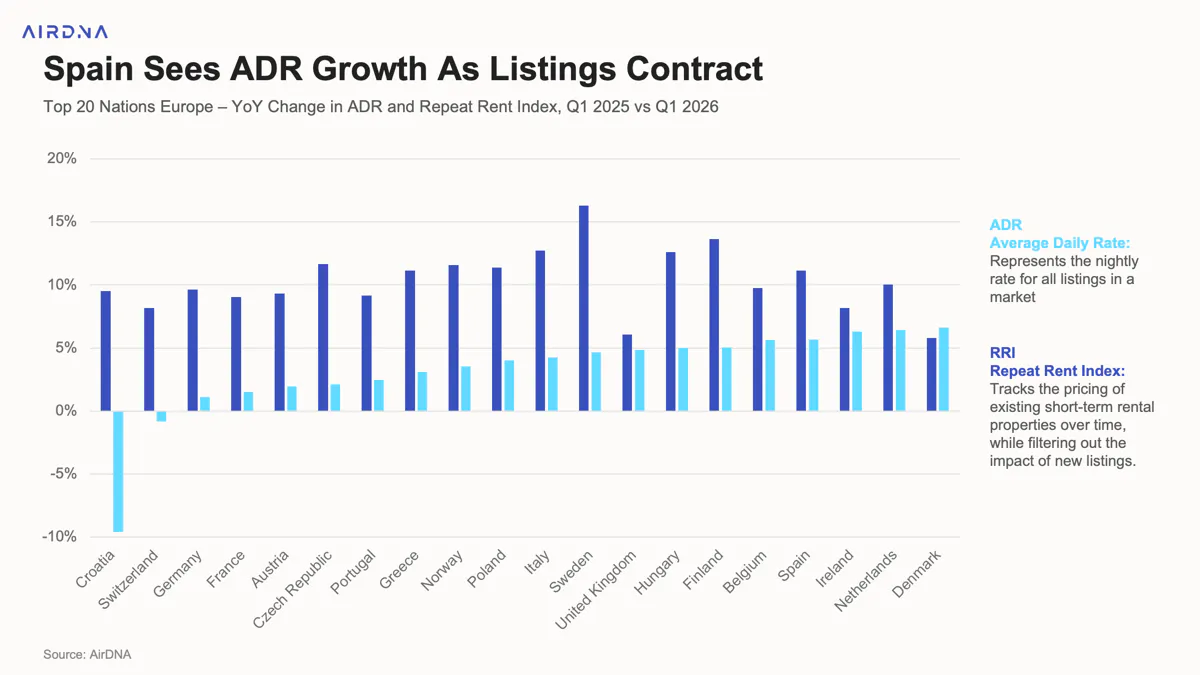
Looking at Europe’s top 20 nations in Q1, all reported strong year-over-year gains in RRI, showing that experienced operators continue to maintain pricing strength. ADR growth was also widespread, with 18 of the 20 nations recording increases during the quarter. Two nations stand out: Croatia, where prices likely declined due to falling demand combined with new, lower-priced supply entering the market, and Switzerland, where demand nights dropped by 9%, likely prompting a similar response from newer operators. Spain also stands out, as months of contracting supply helped maintain occupancy despite declining demand. Existing operators sustained strong pricing, with ADR rising 5.7% YoY in Q1 and RRI increasing 11.1% YoY.
European Summer Pacing
Despite geopolitical tensions, rising inflation risks, and potential impacts on economic growth, summer pacing data remains positive. Demand for the summer period (June through September) is up 8.7% compared to 2025. On a monthly basis, July (+13.3%) and August (+9.5%) stand out with the highest year-over-year gains. September is increasingly becoming a core summer travel month, as more people look to travel beyond the peak season, with demand rising 8.9%, while June has recorded a more modest 2.5% increase.
Although summer pacing looks strong, the K-shaped dynamic observed in Q1 remains in place. Travelers are still taking trips but are more cautious with spending, with more affordable properties leading year-over-year occupancy gains. As shown in the graph below, both budget and economy listings are outpacing higher-end properties in occupancy gains during the summer months, suggesting that demand has shifted down the price ladder rather than weakened overall.
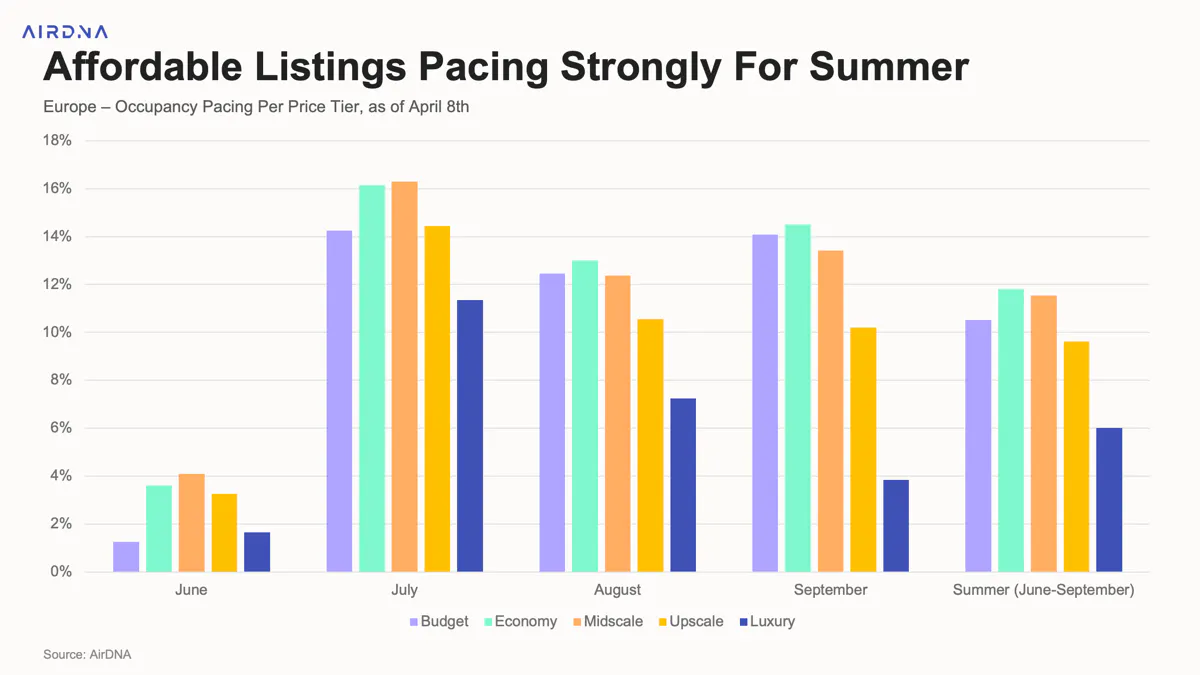
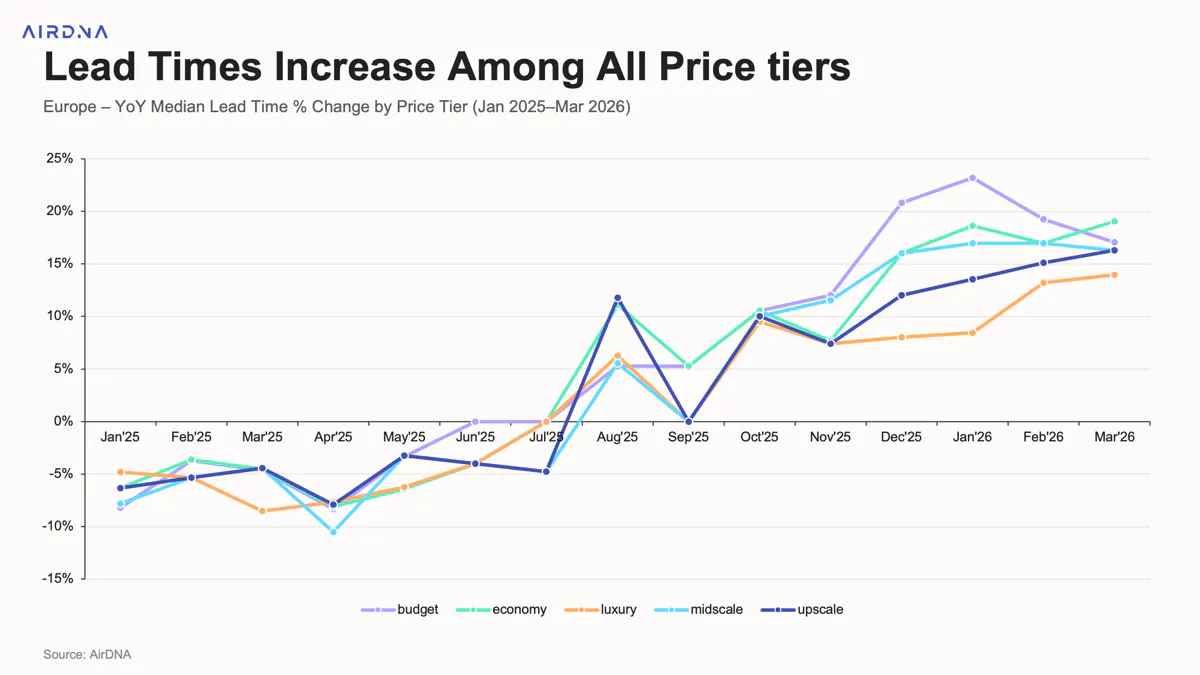
With oil prices remaining elevated and limiting overseas travel options, this strong summer pace may reflect a higher share of domestic travel within Europe. Lead times have also increased steadily across all price tiers, suggesting travelers are booking earlier. It remains unclear whether these gains reflect a sustained shift toward domestic travel or simply earlier booking behavior compared to previous years.
Average Length Of Stay Declines
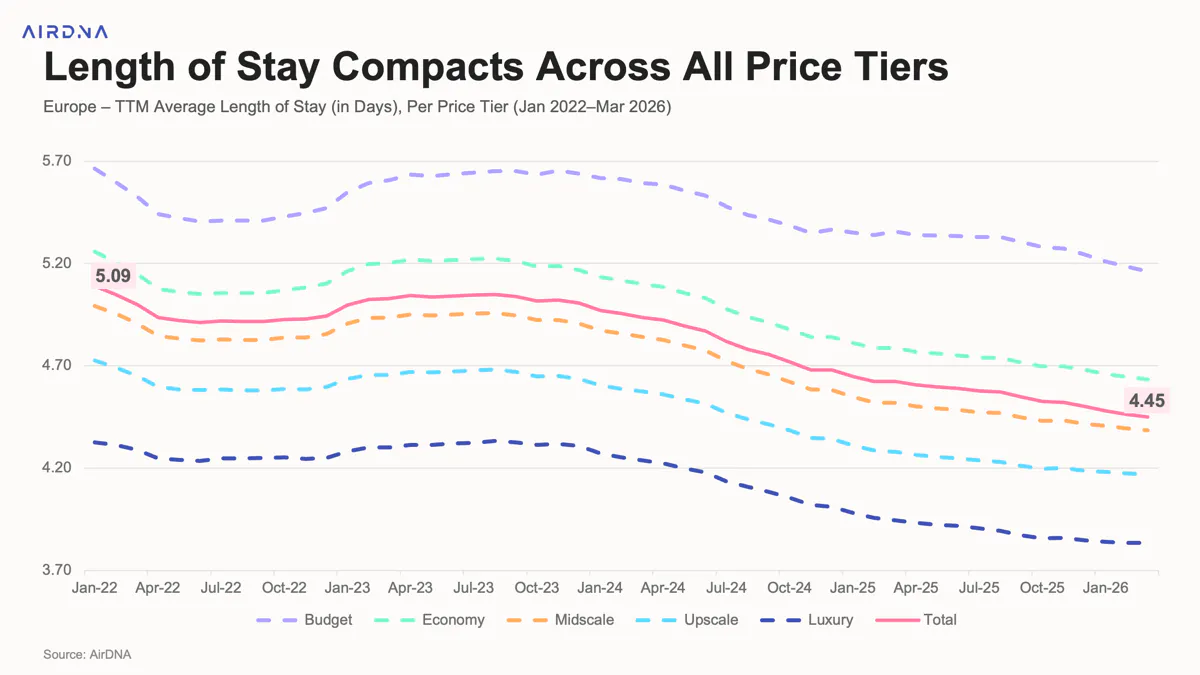
With increased uncertainty in the years following the pandemic, whether from inflation, energy shocks, the cost of living crisis, or sudden tariffs affecting the European economy, travelers have become more cautious with their budgets, favoring shorter getaways over extended stays. At the same time, a shift in traveler behavior is emerging, with more frequent but shorter trips throughout the year rather than a single long holiday.
While the K-shaped dynamic is clearly visible in occupancy patterns, the decline in length of stay cuts across all price tiers, from budget to luxury listings. Even luxury properties, where price sensitivity is presumably lower, have seen their average length of stay drop significantly, from around 5.6 days in 2022 to roughly 4.2 days in 2026. This suggests that shorter stays are less about economic pressure and more about a structural shift in how Europeans travel, with most of the decline beginning in January 2024.
Shorter stays create real challenges for hosts, leading to higher turnover costs, more cleaning cycles, and lower revenue per booking. Operators must offset these pressures through more deliberate pricing strategies, either by managing higher rates or optimizing minimum length-of-stay requirements across their portfolios.
Know when (and why) you're empty
AirDNA helps you spot seasonality trends, booking lead times, and local comps—so you can fill your calendar smarter.
Occupancy Rates In The Middle East
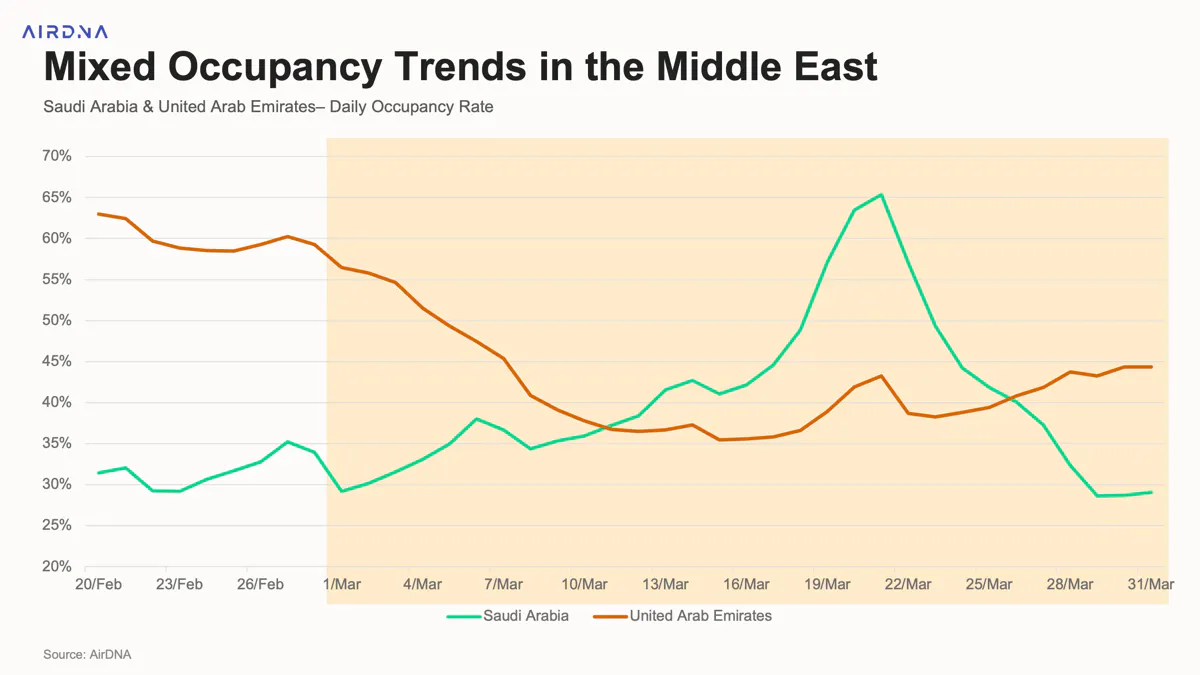
The conflict in the Middle East has had a significant impact on tourism in the region, with demand nights declining across Middle Eastern countries in March and pushing occupancy downward. The United Arab Emirates and Saudi Arabia, the two largest short-term rental markets in the region, saw different trends. In the UAE, occupancy declined sharply at the beginning of the conflict before recovering slightly by the end of March. Despite this improvement, the overall drop was significant, with occupancy rates falling 32.8% YoY in the weeks following the outbreak of the war. Saudi Arabia, on the other hand, saw more stable occupancy throughout the conflict, with rates up 9.3% since the beginning of the period.
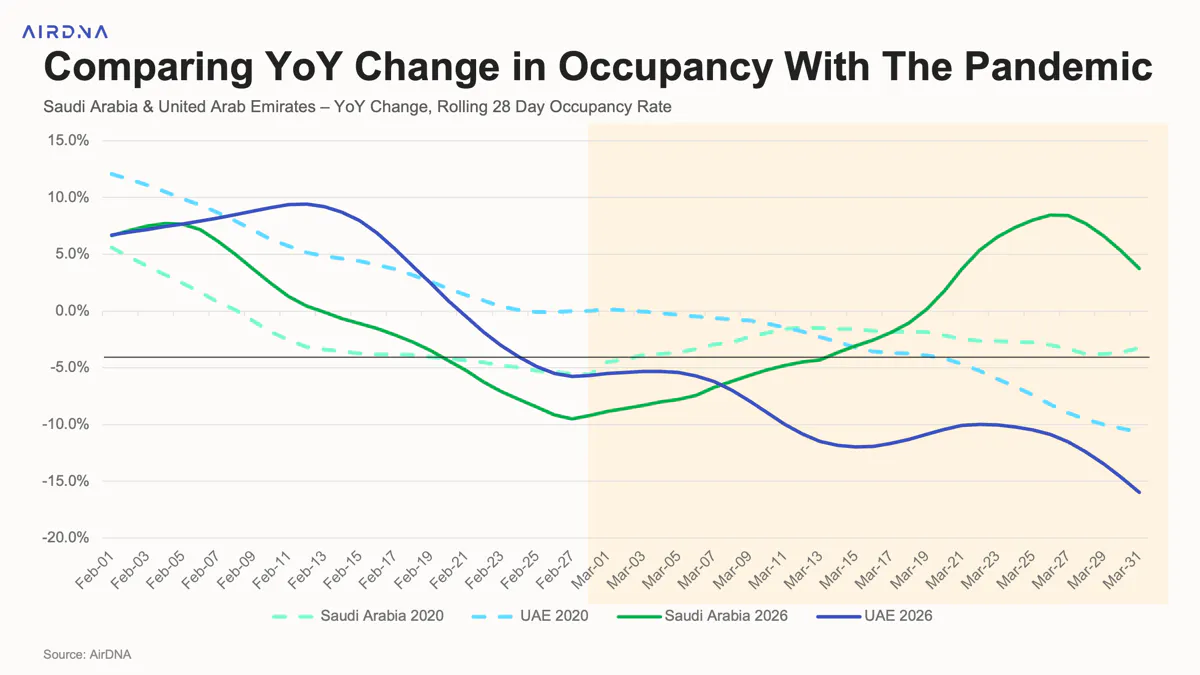
To put the impact of the conflict into perspective, we can compare it to the COVID-19 pandemic. In the United Arab Emirates, declines followed a similar pattern to those seen in 2020, though to a greater degree, which may reflect how much the market has matured since then. In contrast, Saudi Arabia saw a sharper initial decline but recovered quickly, with occupancy increasing in the second half of March as Eid festivities drove demand. With most supply in Saudi Arabia concentrated in Jeddah and Riyadh, the distance from the conflict zone may also have supported the market’s recovery.

Scott Sage
Senior Vice President, Marketing & Customer Experience
Scott is an Airbnb Superhost and industry pro, having founded Home Base BnBs—a short term rental management company that scaled to 200+ units. Scott combines his experience and passion for hosting to empower AirDNA customers' success. When he's not thinking about STRs, he is hiking, playing basketball, or playing pickleball.

